Just as the United States seemed to be turning a corner in its protracted battle against inflation, a new and volatile front has opened. The serene charts of declining consumer price indexes, which had fueled market optimism and hopes for Federal Reserve rate cuts, are now being disrupted by the jagged lines of geopolitical turmoil. The conflict in Gaza and, more consequentially, the sustained disruption to shipping in the Red Sea are injecting a dangerous dose of uncertainty into the global economy, threatening to reignite the very inflation fears that had only just begun to subside.
For over a year, the Fed’s strategy has been focused on taming domestic, demand-driven price pressures. But the current shock is different. It is an external, supply-side shock, emanating from a region thousands of miles away, over which the central bank has no control. This article delves into the intricate mechanism by which conflict in the Middle East is translating into tangible economic pressure on American consumers and businesses. We will trace the path from missile attacks in the Bab el-Mandeb Strait to higher prices on shelves in the American Midwest, analyze the fragile state of the “last mile” of inflation, and explore the agonizing dilemma this creates for the Federal Reserve. This is not merely a story about shipping delays; it is a story about the vulnerability of a globalized economic system and the profound impact of geopolitics on the financial well-being of ordinary Americans.
Part 1: The Epicenter – Mapping the Flashpoints and Their Economic Chokepoints
To understand the economic impact, one must first understand the geography and nature of the disruptions.
1.1 The Gaza Conflict: A Persistent Regional Catalyst
While the tragic human toll of the conflict in Gaza is the primary concern, its economic ramifications stem from its ability to destabilize the wider region. It has provided a motive and a pretext for Iran-backed proxy groups to escalate attacks, transforming a localized war into a regional economic conflict. The Gaza conflict itself is the spark; the Red Sea is the tinderbox it ignited.
1.2 The Red Sea Crisis: An Artery of Global Trade Severed
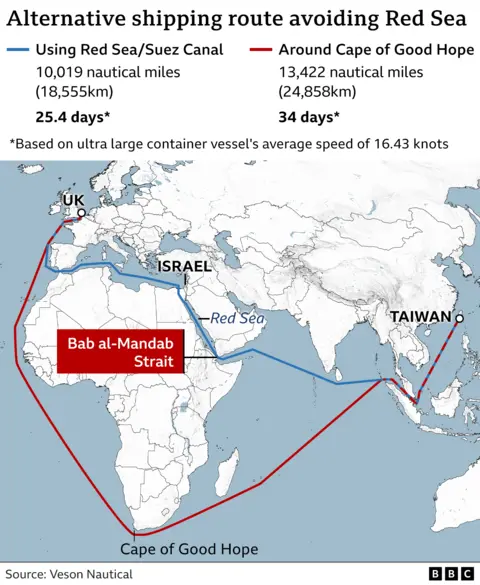
The Bab el-Mandeb Strait, a narrow chokepoint between the Horn of Africa and the Middle East, is one of the world’s most critical maritime passages. It is the gateway to the Suez Canal, the superhighway connecting Asia to Europe and the East Coast of the United States.
- The Houthi Campaign: Since November 2023, Yemen’s Houthi rebels, citing solidarity with Gaza, have conducted over 100 attacks on commercial shipping using drones, missiles, and fast-attack boats. Their targets have been diverse, often linked to Israel, the UK, or the US, but the effect has been to render the passage unsafe for all.
- The Carrier Strike Group Response: The US and UK have led a naval coalition (Operation Prosperity Guardian) to patrol the area and intercept attacks. However, the cost-effectiveness of using multi-million-dollar missiles to shoot down cheap drones is questionable, and the mission has not fully restored carrier confidence.
1.3 The Ripple Effect: The Cape of Good Hope Detour
Faced with an unacceptable risk to crew, cargo, and vessels, virtually all major container shipping lines and a significant portion of oil and gas tanker traffic have stopped using the Red Sea/Suez route. The contingency is a return to the ancient path: sailing around the Cape of Good Hope at the southern tip of Africa.
The Cost of the Detour:
- Time: A round trip from Asia to Europe adds 10-14 days to the journey.
- Fuel: Burning fuel for an extra two weeks is enormously expensive. Freight rates from Asia to the Mediterranean have skyrocketed by over 300% since the attacks began.
- Capacity: Longer voyages mean ships are tied up for more time, effectively reducing global shipping capacity. This creates a vessel shortage, further pushing up rates for all routes, even those not directly using the Suez Canal.
This is not a short-term blip. It is a persistent, structural disruption to the logistics backbone of globalization.
Part 2: The Transmission Mechanism – From Chokepoint to Checkout
The disruption in the Red Sea does not automatically mean higher US inflation. The transmission mechanism operates through several key channels, with a lag of several weeks to months.
2.1 The Direct Channel: Soaring Shipping Costs
The most immediate impact is on global freight rates. The Drewry World Container Index, a key benchmark, vividly illustrates the spike. These increased costs are not absorbed by shipping companies; they are passed down the supply chain as surcharges (e.g., Peak Season Surcharges, Emergency Contingency Surcharges).
- Who Gets Hit First? Importers and retailers who rely on just-in-time inventory or ship goods from Asia. This includes everything from furniture and apparel to electronics and auto parts.
- The “Freight Rate as Leading Indicator” Rule: Sustained high freight rates have been a reliable leading indicator of goods inflation over the past three years, as demonstrated during the COVID shipping crisis.
2.2 The Energy Channel: The Ever-Present Oil Price Threat
The Middle East is the world’s gas station. Any conflict there triggers fears over oil and natural gas supplies.
- Oil Price Sensitivity: While global oil prices have been relatively contained due to strong US production and weak global demand, the risk of a direct confrontation with Iran or a major disruption in the Strait of Hormuz (a far more critical chokepoint) remains a sword of Damocles. A spike to $100+ per barrel would instantly feed into gasoline, diesel, and jet fuel prices, creating a pervasive inflationary tax.
- Liquefied Natural Gas (LNG): Qatar is a major LNG exporter, and significant volumes transit the Suez Canal. Disruptions here, especially if combined with continued pressure on Russian gas, could impact energy prices in Europe, with knock-on effects for global markets.
2.3 The Input Cost Channel: The Squeeze on Manufacturers
Many finished goods and, crucially, components for US manufacturing come from Asia.
- Auto Industry: A missing $5 semiconductor from Taiwan can halt the production of a $50,000 car. The Red Sea disruption creates delays and cost increases for these critical inputs.
- Chemical and Plastics Industries: Europe is a major producer of key chemicals. Delays and higher costs for European imports raise production costs for a vast range of US manufacturers, from plastics to pharmaceuticals.
This “pipeline inflation” takes time to manifest but is often more persistent once it does.
Part 3: The US Inflation Landscape – A Battle Half-Won
To understand why this shock is so concerning, we must assess the state of the US inflation fight as it stood in late 2023.
3.1 The “Easy” Part is Over
The Federal Reserve has successfully brought CPI down from a peak of 9.1% in June 2022 to around 3.1%. This initial disinflation was driven by:
- The unwinding of supply chain snarls from the pandemic.
- The normalization of energy prices after the spike from the Ukraine war.
- The Fed’s aggressive interest rate hikes cooling demand-sensitive sectors like housing.
3.2 The “Last Mile” Problem and the Rise of Services Inflation
The final leg of the journey back to the Fed’s 2% target was always predicted to be the most difficult. Why?
- Sticky Services Inflation: While goods inflation has flatlined or turned negative, services inflation (shelter, healthcare, insurance, dining out) remains stubbornly high. This is largely driven by a strong labor market and rising wages, which are not directly affected by shipping costs but are incredibly persistent.
- The Red Sea Shock Hits at the Worst Time: Just as the Fed was hoping for goods prices to remain stable or fall further to help offset sticky services inflation, the Red Sea crisis threatens to reignite goods inflation. This would mean fighting inflation on two fronts simultaneously—a much more difficult task.
The fear is not a return to 9% inflation, but a stall in disinflation around 3%, forcing the Fed to keep policy restrictive for much longer than markets had hoped.
Part 4: The Fed’s Dilemma – Navigating Between Geopolitics and Monetary Policy
This new supply shock places the Federal Reserve in an excruciating position.
4.1 The Limits of Monetary Policy
Jerome Powell has repeatedly stated that the Fed’s tools are effective for managing demand, but they are blunt instruments for dealing with supply shocks. Raising interest rates cannot unblock the Suez Canal or shoot down Houthi drones. If the Fed overreacts by keeping rates too high for too long to crush demand and compensate for supply-driven price increases, it risks triggering an unnecessary and painful recession.
4.2 The “Higher for Longer” Imperative
Conversely, if the Fed dismisses this shock as transient and pivots too quickly to rate cuts, it risks letting inflation expectations become “de-anchored.” If businesses and consumers start to believe that inflation is permanently higher, they will act accordingly—demanding higher wages and raising prices, creating a self-fulfilling prophecy. Therefore, the most likely Fed response is caution. The mantra of “higher for longer” interest rates will be reinforced, dashing market hopes for imminent and aggressive rate cuts.
4.3 Data Dependence on Steroids
The Fed is now forced to be more data-dependent than ever. It must carefully parse incoming inflation reports to distinguish between one-off price jumps due to shipping and a more generalized reacceleration of inflation. Every CPI and PCE report will be scrutinized for the “geopolitical premium.”
Read more: Beyond China: US Investors’ Guide to Navigating India’s Stock Market Boom
Part 5: Broader Implications for the US Economy and Global Order
The impact extends beyond the monthly inflation report.
5.1 The Corporate Earnings Squeeze
Companies face a difficult choice: absorb the higher costs and take a hit to profit margins, or pass them on to consumers and risk losing price-sensitive customers. Many will opt for a mix, leading to pressure on corporate earnings and potential volatility in equity markets, particularly for retail and transportation stocks.
5.2 The Reassessment of Globalization
The Red Sea crisis is the latest in a series of shocks—the US-China trade war, the pandemic, the war in Ukraine—that is forcing a fundamental rethink of global supply chains. The model of hyper-efficient, long-distance, just-in-time logistics is being revealed as dangerously fragile. Companies are accelerating their “de-risking” and “friend-shoring” strategies, bringing production closer to home or to allied countries. This process is inherently inflationary in the long run, as it sacrifices cost efficiency for resilience.
5.3 The US Geopolitical Burden
The situation underscores the United States’ continued role as the guarantor of global security for trade routes. The deployment of multiple carrier strike groups to the region is a massive military and financial commitment, highlighting the direct link between national security policy and economic stability.
Conclusion: A Fragile Victory and a New Era of Volatility
The battle against US inflation has entered a new and more complex phase. The domestic front, while not yet fully secured, was showing clear signs of improvement. Now, an external front, driven by geopolitical conflict far from American shores, has opened, threatening to undermine that progress.
The path forward is fraught with uncertainty. Its trajectory depends not on economic data alone, but on the duration of the Red Sea crisis, the potential for further escalation in the Middle East, and the ability of global supply chains to adapt. The “transitory” versus “persistent” inflation debate has been reignited.
For the Federal Reserve, the message is clear: the path back to 2% inflation was never going to be smooth, but it has just become significantly more treacherous. For American consumers and businesses, it is a stark reminder that in an interconnected world, their financial security is tethered to stability in distant and volatile regions. The victory over inflation remains fragile, and the world’s unstable geopolitical landscape now holds the pen that will write the final chapters of this economic story.
Read more: Beyond China: US Investors’ Guide to Navigating India’s Stock Market Boom
FAQ Section
Q1: How directly does the Red Sea crisis affect the average American consumer?
Very directly, but with a lag. The average American household will feel the impact in two main ways: 1) Higher prices for imported goods from Asia and Europe, including furniture, clothing, electronics, and certain auto parts, likely in 1-3 months. 2) Potential higher prices for gasoline if the conflict escalates and disrupts oil shipments, which would have a more immediate effect.
Q2: Why can’t the US Navy just secure the Red Sea and end this?
The US Navy is actively trying through Operation Prosperity Guardian. However, the challenge is vast. The Houthis are using relatively cheap drones and missiles, while the US is expending multi-million-dollar interceptors. The area is large, and it is difficult to defend every single commercial vessel. It’s a cost-imposition strategy that is hard to fully neutralize.
Q3: Is this a repeat of the 2021-2022 supply chain crisis?
It is a similar type of shock but likely less severe. The 2021 crisis was a “demand-side” shock (everyone ordering goods at once) combined with COVID-related port closures. This is a “supply-side” shock affecting a specific, albeit critical, route. The global system has more slack now, so the impact should be more contained, but the principle of soaring costs from disrupted logistics is the same.
Q4: What can the Federal Reserve actually do about this?
Very little, directly. The Fed cannot fix supply chains. Its primary tool is influencing demand through interest rates. If this shock leads to a sustained rise in inflation expectations, the Fed will be forced to hold interest rates higher for longer to dampen overall economic demand and prevent a wage-price spiral, even if that increases the risk of a recession.
Q5: Are there any industries that might benefit from this disruption?
Yes, some sectors could see relative benefits. These include:
- Air Freight: Companies like FedEx and UPS may see increased demand for high-value, time-sensitive goods that can’t afford the sea delay.
- Rail and Trucking in Regional Markets: Intra-European and US-Mexico-Canada trade could see a boost as companies seek alternatives to long-distance Asia-Europe shipping.
- Shipping Companies on Unaffected Routes: Rates for routes not using the Suez Canal (e.g., Trans-Pacific) are also rising due to the vessel shortage.
Q6: How long is this disruption expected to last?
There is no clear end in sight. The disruption is directly tied to the duration of the Houthi attacks, which are in turn linked to the conflict in Gaza. Most analysts and companies are planning for disruptions to last for at least the first half of 2024, if not longer. It has moved from a temporary crisis to an ongoing operational challenge.