Summary
Day and swing traders in U.S. equities rely on advanced tools and trading platforms for speed, precision, and risk management. From real-time data feeds and charting software to mobile-friendly brokers and AI-powered screeners, having the right setup determines profitability. This guide explores top platforms, essential tools, strategies, and FAQs to help traders optimize performance and avoid costly mistakes.
Introduction: Why Tools and Platforms Matter in Trading
Day trading and swing trading in the U.S. stock market are fast-paced, high-stakes pursuits. Unlike long-term investors, these traders must make quick decisions based on real-time data, technical indicators, and short-term price action. A delay of even a few seconds can mean missing a breakout or holding onto a losing trade too long.
The difference between success and failure often boils down to the tools and platforms traders use. A robust trading setup provides:
- Real-time market data to react instantly to price changes
- Reliable order execution to enter and exit trades without slippage
- Advanced charting and screeners to identify opportunities quickly
- Risk management tools that help protect capital in volatile conditions
For example, during the 2020 pandemic volatility, traders using platforms with lagging data feeds saw delayed entries compared to those using direct-market-access brokers. The right platform ensured traders could capitalize on historic intraday swings in tech stocks like Tesla and Zoom.
This article dives deep into the best trading platforms and tools for U.S. equities, answering real questions traders ask and offering practical guidance for building a professional-grade trading setup.
What’s the Difference Between Day Trading and Swing Trading Tools?
Both day and swing traders need speed and accuracy, but their tool priorities differ:
- Day traders demand ultra-fast execution and Level II quotes to scalp small price movements.
- Swing traders prioritize screeners, alerts, and charting software for setups spanning days to weeks.
Real-world example: A day trader scalping Apple (AAPL) might need millisecond-level execution, while a swing trader holding NVIDIA (NVDA) through earnings is more concerned with risk/reward ratios and overnight margin requirements.
Top Trading Platforms for U.S. Equities
1. Interactive Brokers (IBKR)
- Best for: Professional traders and swing traders
- Offers direct market access, low commissions, and access to U.S. and global markets
- Advanced charting and IBKR Trader Workstation (TWS) platform
- Many hedge funds and prop traders use IBKR due to its reliability and order routing options
2. Thinkorswim by Charles Schwab
- Best for: Technical analysis and U.S. equities
- Powerful charting, strategy backtesting, and paper trading mode
- Popular among retail traders for its user-friendly yet professional-grade features
- Example: During meme stock rallies (GameStop, AMC), Thinkorswim users had real-time access to volatility indicators
3. TradeStation
- Best for: Active day traders
- Offers fast executions, customizable hotkeys, and strong backtesting
- Integrates with algo-trading strategies
4. TD Ameritrade Mobile & Web
- Best for: Traders who need flexibility across devices
- Provides streaming quotes, news feeds, and educational tools
5. ETRADE Power ETRADE
- Best for: Swing traders and options strategies
- Known for advanced option chains and intuitive charting
6. Webull
- Best for: Beginner day traders
- Commission-free trades, simple interface, and mobile-first design
- Many young traders entering markets during the Robinhood boom pivoted to Webull for broader features
7. Lightspeed Trading
- Best for: Professional scalpers
- Low-latency, high-speed order execution
- Favored by prop firms
Essential Tools Every Day and Swing Trader Should Use
- Real-Time Market Data Feeds → Avoid lag and slippage (e.g., NASDAQ TotalView)
- Level II Quotes & Depth of Market (DOM) → See supply/demand beyond the top of the book
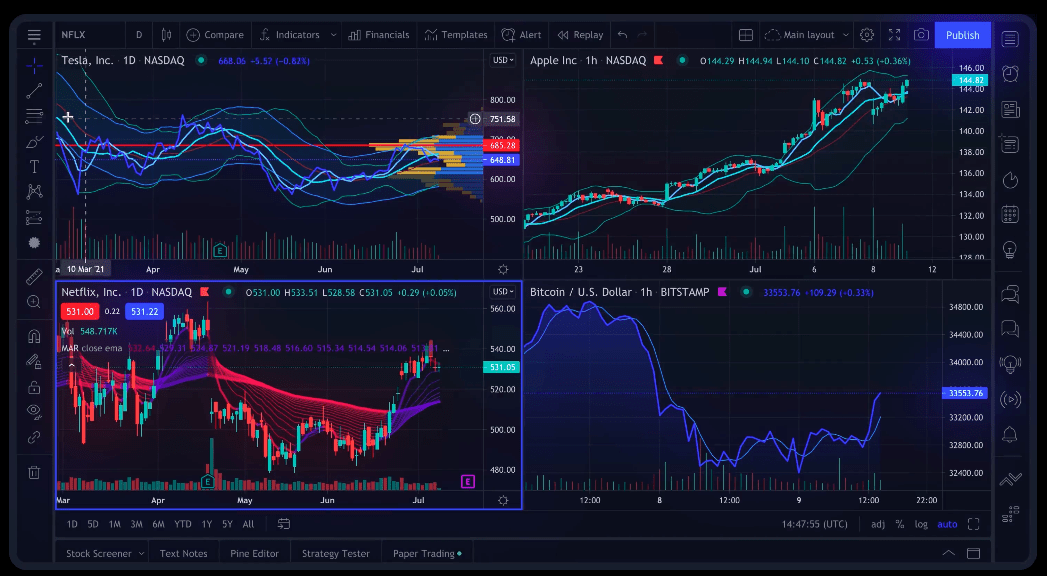
- Charting Software → Platforms like TradingView or Thinkorswim provide detailed candlestick, volume, and indicator analysis
- Screeners → Find setups fast (e.g., Finviz, Trade Ideas)
- News Feeds → Bloomberg Terminal, Benzinga Pro, or free feeds like Yahoo Finance for catalysts
- Risk Management Tools → Stop-loss orders, position sizing calculators
- Mobile Apps → Stay connected on the go
- Backtesting Tools → Test strategies against historical data
Pro Tip: Many successful swing traders combine TradingView for charting with IBKR for execution to balance flexibility and reliability.
How Do Real-Life Traders Use These Platforms?
- Case 1: Day Trader → Maria, a New York–based trader, uses Lightspeed for scalping Tesla during earnings weeks. The platform’s hotkeys allow her to enter and exit trades within seconds, reducing slippage.
- Case 2: Swing Trader → James, a part-time trader, prefers Thinkorswim for its charting and paper trading mode. He backtested swing strategies on S&P 500 ETFs, which gave him confidence before committing capital.
- Case 3: Mobile Trader → Sarah, a traveling professional, trades swing setups using Webull’s mobile app while monitoring alerts from TradingView.
Practical Takeaways for U.S. Equity Traders
- Choose a platform that aligns with your style: speed (day traders) vs. flexibility (swing traders).
- Use multiple tools in combination (execution + charting + screener).
- Backtest strategies before risking capital.
- Don’t ignore risk management tools—profits are secondary if capital is lost.
- Keep mobile access ready for unexpected market moves.
FAQs on Tools & Platforms for Day and Swing Trading U.S. Equities
1. What’s the best platform for beginners in U.S. day trading?
For beginners, Webull and TD Ameritrade’s Thinkorswim are excellent starting points. They offer commission-free trading, intuitive interfaces, and paper trading features. These help new traders practice strategies without risking real money. Over time, as confidence grows, traders can migrate to advanced brokers like Interactive Brokers or TradeStation for more professional-grade execution.
2. Do swing traders need Level II quotes?
Level II quotes are not essential for swing traders, since they hold positions for days or weeks and focus on larger price patterns rather than micro-movements. However, access to Level II data can help in timing precise entries and exits around key levels. Swing traders who trade highly volatile stocks may still find Level II data valuable for added confirmation.
3. How important is execution speed for swing trading?
Execution speed is critical for day traders who rely on quick price movements, but swing traders typically have more time. Still, execution quality cannot be ignored. During earnings announcements or market-wide news, price gaps can occur within seconds. A reliable broker ensures swing traders avoid unnecessary slippage or missed entries, especially in volatile stocks.
4. Are free platforms like Robinhood good for day trading?
Robinhood made trading accessible to millions, but it lacks many professional tools such as Level II quotes, advanced charting, and customizable order types. For casual trading, it may suffice, but serious day traders often face limitations. Those aiming to day trade professionally in U.S. equities are better served by platforms like Lightspeed or Interactive Brokers.
5. Can I trade U.S. equities only with a mobile app?
Yes, mobile-first brokers like Webull and TD Ameritrade Mobile provide full trading functionality. However, professional traders prefer desktop setups because larger screens and advanced tools allow deeper analysis and more precise execution. Mobile apps are best viewed as complementary tools for monitoring trades or placing emergency orders while away from the desk.
6. Which tools are best for finding swing trading setups?
Stock screeners like Finviz and TradingView are invaluable for swing traders. They allow filtering stocks by technical indicators such as moving averages, RSI, and MACD, or by fundamental factors like earnings growth. For example, many traders used Finviz to spot oversold conditions in bank stocks during 2023 regional banking volatility, creating profitable swing opportunities.
7. What’s the role of news feeds in day trading?
News feeds are essential in day trading because price action often reacts to breaking news before charts reflect it. Traders with instant access to Benzinga Pro or Bloomberg Terminal gain an edge by entering trades seconds ahead of others. For instance, biotech stocks often spike on FDA announcements, and traders with news alerts capitalize early.
8. Can I automate trades on these platforms?
Yes. Platforms like TradeStation and Interactive Brokers allow API-based or algorithmic trading. Automation helps systematic traders execute pre-defined strategies without emotional interference. However, automation requires coding knowledge, robust backtesting, and strict risk management. Many professionals use automation for specific setups but still monitor trades to avoid unexpected market shocks.
9. What is the best charting software for technical analysis?
TradingView stands out as one of the most popular charting platforms due to its user-friendly design, broad indicator library, and community-driven trade ideas. Thinkorswim is another strong choice, offering professional-grade charting and options analysis. Serious traders often pair a charting tool like TradingView with a reliable broker for execution, creating a more complete ecosystem.
10. Do I need multiple platforms?
In practice, many traders do use multiple platforms. For instance, a trader may use Interactive Brokers for order execution while relying on TradingView for charting and Finviz for screening. Combining platforms ensures traders get the best of each tool without compromise. The key is to avoid overcomplication—choose a combination that supports your style and keeps your workflow efficient.
Final Thoughts
Day and swing trading in U.S. equities demand more than instinct—they require reliable platforms and the right tools. The difference between lagging behind and staying ahead in the market often depends on execution speed, charting precision, and risk management.
Whether you’re a beginner or an advanced trader, investing in the right platform and tool combination is as crucial as refining your trading strategy. Markets will always be uncertain, but your setup does not have to be.