Summary
The U.S. stock market often pivots between technology and energy as its driving forces. Tech stocks dominate during innovation-led booms, while energy leads during commodity upswings and inflationary cycles. This article explores the rivalry between these two powerhouse sectors, analyzing performance trends, catalysts, and risks. Real-life examples, data-backed insights, and FAQs help investors navigate where leadership may shift in the years ahead.
Introduction: Why the Tech vs. Energy Debate Matters
Few rivalries in the U.S. stock market are as captivating as the ongoing battle between technology and energy. These two sectors represent different faces of American capitalism—one rooted in innovation and digital transformation, the other grounded in natural resources and industrial power.
- Technology stocks like Apple, Microsoft, and NVIDIA have reshaped global commerce, fueling growth in artificial intelligence, cloud computing, and semiconductors.
- Energy giants such as ExxonMobil, Chevron, and ConocoPhillips continue to power economies, often driving profits when oil and gas prices surge.
The question of which sector will lead U.S. equities is not just academic—it directly impacts portfolios, retirement accounts, and market sentiment. When tech rallies, the Nasdaq often outpaces the S&P 500. When energy rallies, it signals inflationary pressures and cyclical rotations.
Real-world context: In 2022, energy stocks surged over 60% amid soaring oil prices after Russia’s invasion of Ukraine, while tech stocks fell sharply due to rising interest rates. By 2023–2024, the pendulum swung back, with AI-driven enthusiasm pushing tech to record highs.
This back-and-forth demonstrates why investors, traders, and policymakers alike must pay attention to the tech vs. energy narrative.
Historical Shifts: When Tech Led, When Energy Led
The U.S. market has seen rotations of sector leadership throughout history:
- 1970s Energy Boom: Oil shocks pushed energy stocks to dominate, as companies like Exxon (now ExxonMobil) became market titans.
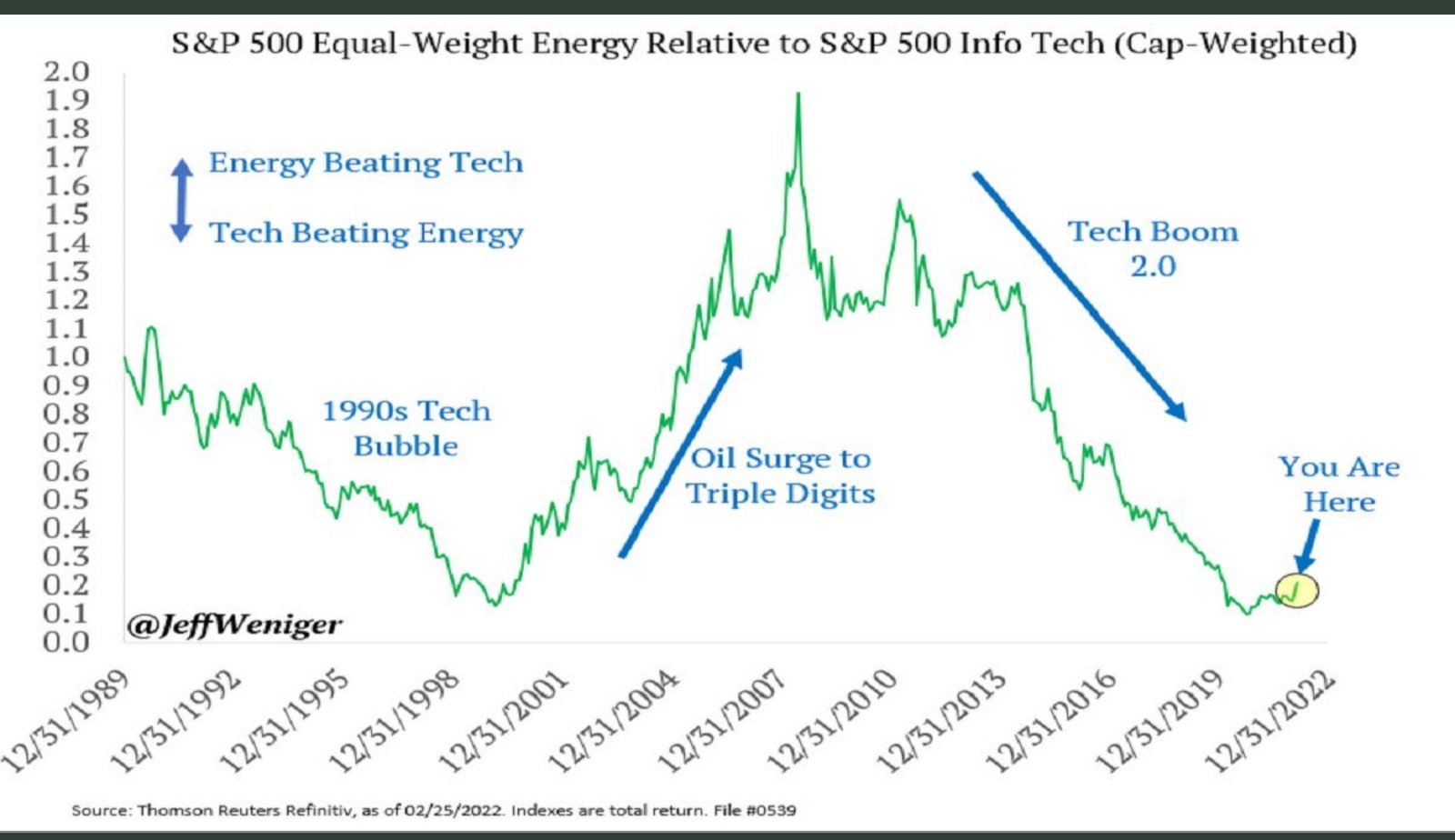
- 1990s Tech Bubble: Microsoft, Cisco, and Intel led the dot-com surge, reshaping the S&P 500’s weighting.
- 2000s Commodity Supercycle: Energy and materials surged as China’s industrial growth boosted demand for oil and gas.
- 2010s Tech Renaissance: Apple, Amazon, and Google drove U.S. equities to record highs, with energy lagging amid low oil prices.
- 2022 Energy Comeback: The sector outperformed every other as geopolitical tensions spiked crude oil.
- 2023–2025 Tech Reclaiming Leadership: AI optimism and mega-cap tech dominance returned, making tech stocks once again market drivers.
Each rotation reveals a cyclical battle shaped by interest rates, global demand, and innovation cycles.

Performance Comparison: Tech vs. Energy in Numbers
According to S&P Dow Jones Indices data:
- Technology (S&P 500 Information Technology sector): Delivered an average annualized return of 17.1% over the last 10 years (2013–2023).
- Energy (S&P 500 Energy sector): Returned 4.2% annualized over the same period, but with sharp outperformance in years of oil price spikes (e.g., +65.7% in 2022).
This illustrates that tech dominates over long horizons, but energy offers short-term bursts of leadership during inflationary cycles or supply shocks.
Key Catalysts for Tech Sector Growth
Technology thrives when innovation and low interest rates align. Current drivers include:
- Artificial Intelligence (AI): NVIDIA’s market cap surpassed $3 trillion in 2024, driven by demand for AI chips.
- Cloud Computing & SaaS: Amazon (AWS), Microsoft (Azure), and Google Cloud continue to expand margins.
- Consumer Electronics: Apple’s ecosystem—from iPhones to wearables—anchors global tech adoption.
- Digital Transformation: Enterprises increasingly rely on automation, cybersecurity, and data analytics.
Case study: In 2023, Microsoft’s integration of AI into Office 365 boosted demand, lifting its stock to all-time highs despite broader market volatility.
Key Catalysts for Energy Sector Growth
Energy outperforms during commodity booms and geopolitical uncertainty. Drivers include:
- Oil Prices: Higher crude prices boost margins for Exxon, Chevron, and ConocoPhillips.
- Geopolitical Risks: Conflicts in the Middle East or supply disruptions create short-term energy rallies.
- Dividends: Energy stocks often offer higher yields than tech, appealing to income-focused investors.
- Transition Dynamics: While renewables rise, traditional oil and gas remain vital in the medium term.
Case study: In 2022, ExxonMobil posted record profits exceeding $55 billion, its best year ever, directly fueled by soaring crude prices.
Interest Rates and Inflation: Who Wins?
- Tech stocks typically struggle in high-rate environments. Their valuations rely on future cash flows, which are discounted more heavily when rates rise.
- Energy stocks often thrive during inflationary periods, as commodity prices rise and investors seek real assets as hedges.
Example: In 2022, when the Federal Reserve raised rates aggressively, tech valuations compressed, while energy rallied on oil’s surge above $100/barrel.
ESG, Climate, and the Future of Energy Leadership
The rise of Environmental, Social, and Governance (ESG) investing has pressured energy companies. Yet paradoxically, demand for oil remains high.
- Renewables like solar, wind, and hydrogen attract investment, but they remain a fraction of global energy consumption.
- Oil majors are diversifying, but critics argue progress is slow.
- Tech firms, meanwhile, are major consumers of energy to power data centers, creating an interlinked story of reliance.
This dynamic raises the question: will tech’s clean image eventually outweigh energy’s cyclical strength?
Practical Advice: Balancing Tech and Energy in Portfolios
For investors, the rivalry between tech and energy is not about choosing one or the other—it’s about balancing exposure based on market cycles.
- In low-rate, innovation-driven markets: Overweight technology.
- In high inflation or commodity booms: Tilt toward energy.
- For diversification: Hold a mix of both, using sector ETFs like XLK (Tech) and XLE (Energy).
Real-life portfolio example: An investor in 2020–2022 who held both XLK and XLE would have smoothed returns. While XLK underperformed in 2022, XLE’s +65% gains offset losses.
FAQs on Tech vs. Energy in U.S. Equities
1. Why do tech stocks usually outperform energy stocks over the long term?
Tech stocks benefit from continuous innovation, scalability, and recurring revenue models. Companies like Apple and Microsoft generate massive free cash flow and expand globally with relatively low incremental costs. Energy stocks, while profitable during commodity booms, are more cyclical and tied to volatile oil and gas prices. Over decades, technology’s growth compounds more effectively.
2. Why did energy outperform tech in 2022?
In 2022, Russia’s invasion of Ukraine disrupted global oil supplies, pushing crude prices above $100 per barrel. This drove energy companies’ profits to record highs. Meanwhile, rising U.S. interest rates compressed tech stock valuations, leading to a rare reversal where energy vastly outperformed technology. This highlighted how macroeconomic shocks can quickly shift sector leadership.
3. Can tech and energy perform well at the same time?
Yes. While often seen as rivals, both sectors can rise together under certain conditions. For example, during post-recession recoveries, tech benefits from digital adoption while energy rises on increased industrial demand. In 2021, tech surged on pandemic-driven digitization, while energy rebounded strongly from 2020 lows as travel resumed and oil demand recovered.
4. Are energy stocks still relevant in a renewable-driven future?
Yes. While renewables are growing, oil and gas remain essential for transportation, industrial use, and even powering renewable infrastructure itself. According to the U.S. Energy Information Administration (EIA), fossil fuels will still account for over 60% of energy consumption in 2050. Energy companies are also investing in renewable projects, ensuring ongoing relevance.
5. How do interest rates affect tech vs. energy performance?
Higher interest rates typically hurt tech valuations since they rely on future earnings growth. Energy, however, can benefit during inflationary cycles, as commodity prices rise alongside costs. For instance, in 2022, tech stocks corrected sharply with rising rates, while energy thrived due to inflation-driven oil price increases.
6. Which sector is better for dividend investors: tech or energy?
Energy stocks are traditionally favored by dividend investors. Companies like ExxonMobil and Chevron yield between 3–5%, compared to tech giants like Apple or Microsoft, which yield around 0.5–1%. While tech companies prefer reinvesting profits into innovation, energy companies often return capital directly to shareholders.
7. Are tech stocks riskier than energy stocks?
Both carry risks, but in different forms. Tech stocks are vulnerable to valuation bubbles, regulatory scrutiny, and innovation cycles. Energy stocks are highly sensitive to geopolitical events, commodity price swings, and climate policy. Diversification across both sectors reduces overall portfolio risk.
8. Which ETFs best capture tech vs. energy performance?
For technology, XLK (Technology Select Sector SPDR ETF) is a popular choice. For energy, XLE (Energy Select Sector SPDR ETF) tracks leading oil and gas companies. Investors often compare XLK vs. XLE to monitor sector rotation and adjust allocations accordingly.
9. How does AI adoption affect both sectors?
AI is primarily a tech growth driver, but it also increases energy demand. Training AI models requires massive data center capacity, which consumes electricity, much of it still generated from fossil fuels. This creates a feedback loop where tech’s growth indirectly supports energy demand, intertwining the sectors.
10. Will tech permanently dominate energy in market leadership?
Not permanently. While tech has greater long-term growth potential, energy’s cyclical strength ensures it will continue to have periods of outperformance. Market leadership will likely rotate depending on interest rates, inflation, and global demand. Smart investors prepare for both possibilities rather than betting solely on one sector.
Final Thoughts
The battle between technology and energy for market leadership in U.S. equities reflects deeper themes of innovation, resource dependency, and macroeconomic shifts. Tech has delivered sustained outperformance through scalability and innovation, while energy remains vital as a cyclical powerhouse and inflation hedge.
For investors, the lesson is clear: sector leadership rotates. The most resilient portfolios are those that adapt, balancing growth-oriented technology with income-generating, inflation-resistant energy exposure.