Summary
Short-term trading and long-term investing represent two contrasting approaches to wealth building in U.S. markets. Traders seek rapid profits from market swings, while investors aim for compounding over decades. This article explains the differences, money management strategies, risks, and psychological challenges of both approaches, helping Americans choose the right path for their financial goals.
Introduction: Why This Debate Matters More Than Ever
The U.S. stock market has long been a place where fortunes are made and lost. For some, the thrill of short-term trading—jumping in and out of stocks, options, or ETFs for quick gains—offers excitement and profit opportunities. For others, long-term investing—patiently holding assets for years—feels safer and aligns with retirement planning.
In 2025, with inflation still shaping Federal Reserve policy, rising interest rates, and market volatility, Americans are asking: Is it smarter to trade short-term or invest long-term? The truth is, there’s no one-size-fits-all answer. Instead, it depends on your money management strategy, risk tolerance, and personal financial goals.
This article unpacks both approaches in detail—backed by data, examples, and practical takeaways.
What Is Short-Term Trading in U.S. Markets?
Short-term trading refers to buying and selling securities within days, weeks, or even minutes. Popular forms include day trading, swing trading, and options trading.
Key Features:
- Time Horizon: Hours to weeks.
- Goal: Capture market volatility and short-lived price movements.
- Instruments: Stocks, ETFs, options, futures, and forex.
- Skill Requirement: High—requires technical analysis, real-time monitoring, and discipline.
Example:
During the meme stock craze of 2021, day traders on Reddit’s WallStreetBets rode AMC and GameStop shares, turning a few thousand dollars into six-figure profits in weeks. But many latecomers lost heavily when prices crashed.
What Is Long-Term Investing?
Long-term investing focuses on holding assets—such as blue-chip stocks, index funds, bonds, or real estate—for years or decades. The aim is to benefit from compound growth, dividends, and economic expansion.
Key Features:
- Time Horizon: Years to decades.
- Goal: Build sustainable wealth and financial security.
- Instruments: Index funds, ETFs, bonds, retirement accounts (401k, IRA).
- Skill Requirement: Moderate—requires patience, diversification, and risk management.
Example:
Warren Buffett famously bought Coca-Cola shares in 1988 and still holds them. That $1.3 billion investment has generated billions in dividends alone, proving the power of compounding.
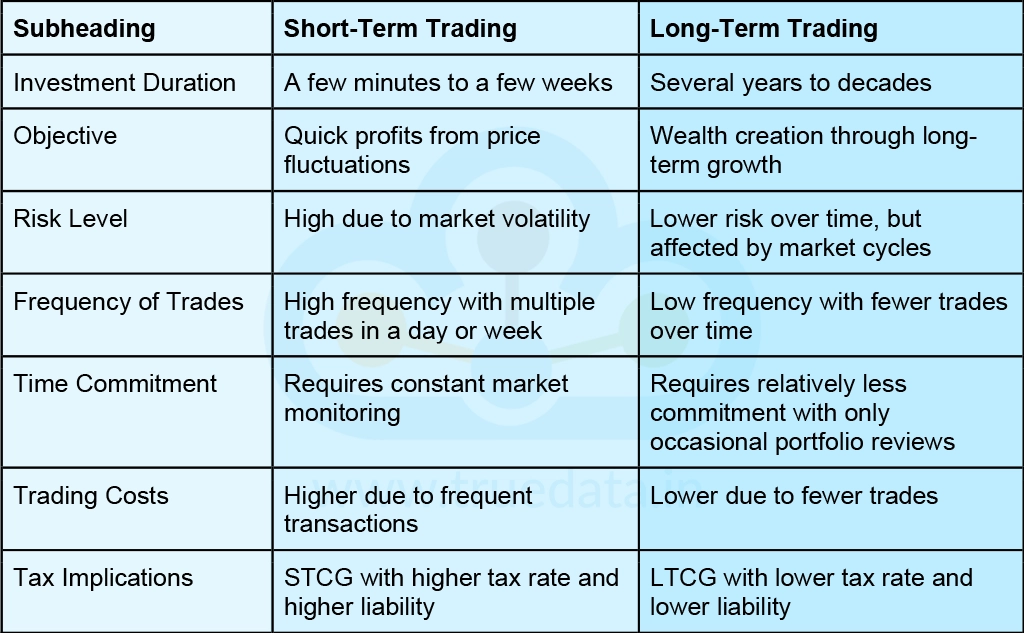
Short-Term Trading vs. Long-Term Investing: Key Differences
| Factor | Short-Term Trading | Long-Term Investing |
|---|---|---|
| Time Horizon | Minutes to weeks | Years to decades |
| Primary Goal | Quick profits | Wealth accumulation |
| Risk Level | High (volatile) | Moderate (market cycles) |
| Tax Treatment | Short-term capital gains (higher tax rate) | Long-term capital gains (lower rate) |
| Psychological Demand | Stressful, high pressure | Requires patience and discipline |
| Money Management | Stop-loss orders, position sizing | Asset allocation, diversification |
How Do Money Management Strategies Differ Between the Two?
For Short-Term Traders:
- Risk Per Trade: Most professional traders risk only 1–2% of capital per trade.
- Stop-Loss Orders: Crucial to cap losses in fast-moving markets.
- Position Sizing: Adjust position size to volatility (e.g., trade fewer shares of Tesla than Coca-Cola).
- Daily Review: Traders must analyze performance and refine strategies.
For Long-Term Investors:
- Diversification: Spread risk across sectors (tech, energy, healthcare).
- Dollar-Cost Averaging (DCA): Invest fixed amounts regularly to smooth volatility.
- Rebalancing: Adjust portfolio allocations annually.
- Emergency Fund: Keep 6–12 months of expenses liquid to avoid forced selling.
Which Approach Builds Wealth Faster?
Short-term trading can generate rapid gains but also fast losses. A Charles Schwab study (2022) found that only about 1% of active day traders consistently outperform the market.
By contrast, the S&P 500 has returned an average of 10% annually over the past 50 years. Investors who stayed invested during downturns (2008 crisis, 2020 pandemic crash) saw long-term growth.
Key Takeaway:
Trading might create quick wins, but investing steadily builds wealth for retirement, education funds, or generational planning.
Psychological Differences Between Traders and Investors
Money management is not just numbers—it’s emotional discipline.
- Traders battle fear and greed daily, with impulsive decisions leading to losses.
- Investors fight impatience, often selling too soon or panicking during downturns.
Real-Life Example:
In March 2020, panic selling drove markets down 30%. Traders who shorted stocks profited, but long-term investors who held—or bought more—recovered and doubled gains by 2021.
Tax Implications in the U.S.
- Short-Term Trading: Profits are taxed as ordinary income (up to 37% for high earners).
- Long-Term Investing: Gains held over a year are taxed at 0–20%, depending on income.
This tax advantage often tilts money management in favor of long-term investing.
Common Mistakes in Each Approach
Short-Term Trading Mistakes:
- Overleveraging with margin accounts.
- Ignoring stop-losses.
- Trading emotionally after losses.
- Lack of a clear strategy.
Long-Term Investing Mistakes:
- Concentrating too heavily in one stock or sector.
- Trying to time the market.
- Neglecting to rebalance portfolios.
- Pulling out during downturns instead of holding.
Which Is Right for You?
Ask yourself:
- Do you enjoy analyzing charts daily? → Short-term trading may fit.
- Do you prefer low-stress wealth building? → Long-term investing is ideal.
- Do you have high risk tolerance and spare capital? → Trading could be an option.
- Do you prioritize retirement savings and stability? → Investing works best.
Practical Money Management Tips for Americans
- Always separate trading capital from long-term savings.
- Automate long-term investments through 401(k) contributions.
- Use trading profits (if any) to fund retirement accounts.
- Avoid debt-driven investing—especially in volatile assets.
FAQs: Short-Term Trading vs. Long-Term Investing
1. Is short-term trading more profitable than long-term investing?
Short-term trading can be more profitable if done successfully, but very few traders sustain consistent gains. Long-term investing, while slower, has historically outperformed most traders thanks to compounding and lower taxes. For most Americans, investing steadily in index funds outpaces risky day trading.
2. How much money do I need to start short-term trading?
While U.S. brokers allow accounts with as little as $500, the Pattern Day Trader Rule requires $25,000 minimum for unlimited day trades. Beginners should start small—only with money they can afford to lose—while focusing on learning risk management before scaling up.
3. Can I combine trading and investing strategies?
Yes. Many Americans use a “core-satellite” strategy—holding a diversified long-term portfolio as the core, while allocating 5–10% to short-term trades. This allows exposure to potential quick wins without jeopardizing retirement security.
4. Which is riskier: short-term trading or long-term investing?
Short-term trading is riskier due to leverage, volatility, and emotional decision-making. Long-term investing carries risks too (inflation, market crashes), but historically, broad index funds like the S&P 500 recover and grow over decades.
5. Do professional traders actually make money?
Some do, but statistics show most retail traders lose money over time. A 2019 study by the Brazilian Securities Commission found 97% of day traders lost money after 300 days. By contrast, investors in low-cost index funds generally saw positive returns.
6. How do taxes affect my decision between trading and investing?
Short-term gains are taxed at higher ordinary income rates, while long-term gains enjoy preferential rates. Over decades, this tax drag can significantly reduce trader profits compared to long-term investors.
7. What tools are best for short-term traders?
Day traders often rely on platforms like Thinkorswim (TD Ameritrade), Interactive Brokers, or TradingView for charting and execution. Long-term investors may prefer Vanguard, Fidelity, or Schwab for low-cost index funds and retirement accounts.
8. Should I quit my job to become a trader?
Most experts advise against quitting stable employment for full-time trading, especially without years of consistent profitability. Trading is extremely demanding and stressful, while long-term investing can be done passively alongside a career.
9. Can long-term investing fail?
Yes—if investors concentrate in a single asset (like Enron or Lehman Brothers stock). Diversification and patience are critical. Even during the Great Depression, diversified portfolios eventually recovered.
10. Which strategy works better during high inflation?
In inflationary periods, traders may profit from volatility, but long-term investors can hedge by holding sectors like energy, commodities, or TIPS (Treasury Inflation-Protected Securities). Historically, equities have outpaced inflation when held long-term.
Conclusion: Balancing Short-Term Gains with Long-Term Goals
The debate between short-term trading and long-term investing boils down to risk appetite, time commitment, and financial objectives. While trading can bring excitement and rapid gains, most Americans achieve sustainable wealth through disciplined, long-term investing. A blended approach—investing for the future while cautiously trading with a small portion of capital—offers balance.