If you’re one of the millions of Americans carrying debt, you know it’s more than just a number on a statement. It’s a source of stress, a constraint on your choices, and a barrier between you and your financial goals. The average American household carries over $100,000 in debt, including mortgages, and faces thousands in high-interest credit card and loan balances.
The desire to be debt-free is universal, but the path can feel overwhelming. You’ve likely heard the advice: “Just pay more than the minimum!” But how you apply that extra payment can dramatically accelerate your journey and transform your mindset.
This article delves into the two most powerful and proven debt repayment strategies: the Debt Avalanche and the Debt Snowball. We will dissect them with the rigor of a financial analyst and the empathy of a trusted coach. Our goal is not to declare one the universal winner, but to provide you with the evidence, insights, and self-assessment tools to choose the strategy that is right for your brain, your behavior, and your financial situation.
This article is built on the principles of EEAT (Experience, Expertise, Authoritativeness, and Trustworthiness):
- Experience & Expertise: We explore the psychological and mathematical foundations of each method, citing research and financial experts.
- Authoritativeness: Data and context are drawn from authoritative U.S. sources like the Federal Reserve, National Foundation for Credit Counseling (NFCC), and academic studies.
- Trustworthiness: Our aim is to provide balanced, accurate, and actionable information. We will highlight the pros and cons of each method and emphasize that the “best” strategy is the one you will stick with.
Part 1: Understanding the Battlefield – The Anatomy of American Debt
Before we charge into battle, we must understand the enemy. Not all debt is created equal.
1.1. The Common Types of Consumer Debt in the U.S.
- Credit Card Debt: Public enemy number one. With Average Percentage Rates (APRs) often soaring between 20-30%, this is the most toxic and expensive form of debt for most Americans. It grows rapidly and can take decades to pay off if only making minimum payments.
- Personal Loans: Often used for debt consolidation, home improvements, or major purchases. Interest rates can vary widely based on creditworthiness, from 6% to 36%.
- Auto Loans: A common installment debt. While interest rates are generally lower than credit cards, the large principal means you pay significant interest over the life of the loan.
- Student Loans: A massive financial burden for many, with unique repayment plans and forgiveness options. Federal loan interest rates are fixed, while private loans can be variable.
- Mortgages: “Good debt” due to its typically low interest rate and the fact it builds equity in an asset. It’s generally the last priority in an aggressive debt payoff plan.
1.2. The Crucial Concepts: Principal, Interest, and Minimum Payments
- Principal: The original amount of money you borrowed.
- Interest: The cost of borrowing that money, expressed as an annual percentage rate (APR).
- Minimum Payment: The smallest amount you can pay each month to keep your account in good standing. This is a trap. Lenders design minimum payments to keep you in debt for as long as possible, maximizing the interest you pay.
The Power of an Extra Payment: Every dollar you pay above the minimum goes directly toward reducing your principal. A lower principal means less interest charged next month, creating a powerful positive feedback loop. The Avalanche and Snowball methods are simply different ways to direct this “extra payment” for maximum effect.
Part 2: The Debt Avalanche Method – The Mathematical Masterpiece
The Debt Avalanche, also known as debt stacking, is the strategy favored by number-crunchers, financial purists, and anyone focused on optimizing for the lowest total cost.
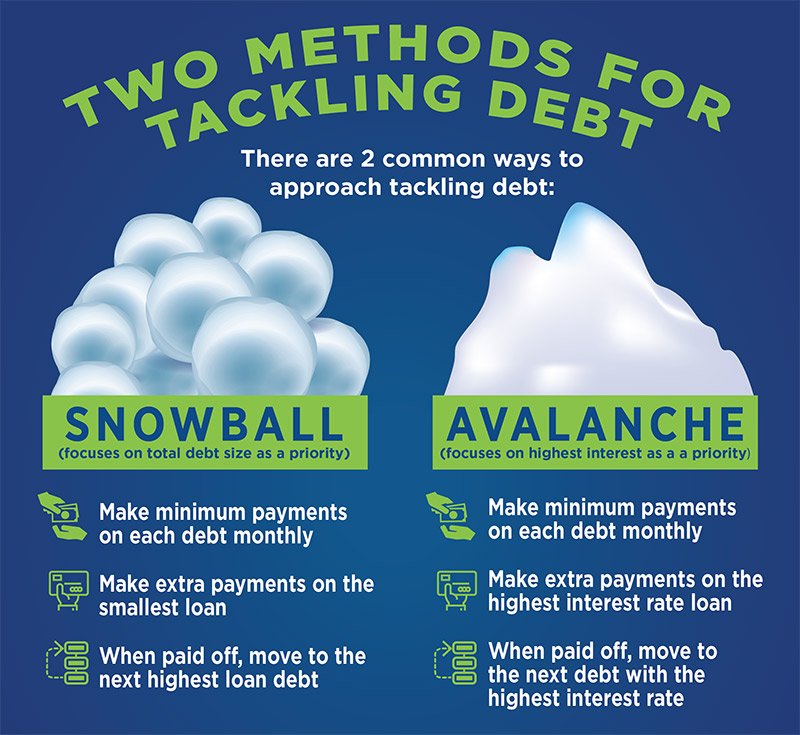
How the Debt Avalanche Works: A Step-by-Step Guide
- List Your Debts: List all your non-mortgage debts from the highest interest rate to the lowest, regardless of the balance.
- Make Minimum Payments: Continue making the minimum monthly payment on every single debt.
- Attack the Highest-Interest Debt: Throw every spare dollar of your “extra payment” budget at the debt with the highest APR.
- Snowflake the Payment: Once the highest-interest debt is paid off, take the entire amount you were paying toward it (the minimum payment + the extra payment) and “snowflake” it onto the next debt on your list (the one with the new highest interest rate).
- Repeat: Continue this process, rolling over the growing payment amount each time a debt is eliminated, until all debts are gone.
A Concrete Example of the Debt Avalanche
Let’s meet Alex, The Analyst. Alex has a total of $15,000 in debt and can afford a total of $800 per month toward debt repayment.
| Debt | Balance | APR | Minimum Payment |
|---|---|---|---|
| Credit Card A | $6,000 | 24.99% | $180 |
| Personal Loan | $5,000 | 11.00% | $150 |
| Auto Loan | $4,000 | 6.00% | $120 |
| Total | $15,000 | $450 |
Alex has $350 left over ($800 total – $450 in minimums) to use as his “extra payment.”
- Phase 1: Alex pays the minimums on the Personal Loan ($150) and Auto Loan ($120). He throws every extra dollar ($350) at Credit Card A. His total monthly payment to Credit Card A is $180 (min) + $350 (extra) = $530.
- Phase 2: After ~13 months, Credit Card A is paid off! Alex now rolls the entire $530 he was paying on that card onto the Personal Loan. He continues the $150 minimum payment, but now adds the $530 snowflake. His total payment to the Personal Loan is $680.
- Phase 3: The Personal Loan is demolished quickly. He then rolls the full $680 onto the Auto Loan’s $120 minimum, attacking it with $800 per month until it’s gone.
The Result: Using a debt avalanche calculator, Alex will be debt-free in approximately 23 months and will pay a total of $1,850 in interest.
The Undeniable Advantages of the Avalanche Method
- Mathematically Superior: This method will always result in the least amount of interest paid over time compared to any other repayment order.
- Faster Overall Debt Freedom (Theoretically): Because you’re eliminating the most expensive debt first, you reduce the total interest accrual, which can lead to a faster overall debt-free date.
- Financially Efficient: It’s the most rational use of your capital, treating debt as a purely mathematical problem.
The Psychological Drawbacks of the Avalanche Method
- Delayed Gratification: If your highest-interest debt is also your largest balance (a common scenario), it can take a long time to achieve that first “win.” Months can go by without paying off a single account, leading to frustration and demotivation.
- The Willpower Tax: It requires significant discipline to stay focused on a long, slow grind without the psychological reinforcement of a quick victory.
Read more: Is Investment Diversification in the U.S. Portfolio Truly a Smart Idea Right Now?
Part 3: The Debt Snowball Method – The Behavioral Powerhouse
The Debt Snowball method, popularized by personal finance expert Dave Ramsey, prioritizes human psychology over pure math. It’s designed to build momentum and create a sense of winning.
How the Debt Snowball Works: A Step-by-Step Guide
- List Your Debts: List all your non-mortgage debts from the smallest outstanding balance to the largest, regardless of the interest rate.
- Make Minimum Payments: Continue making the minimum monthly payment on every single debt.
- Attack the Smallest Balance: Throw every spare dollar of your “extra payment” budget at the debt with the smallest balance.
- Celebrate and Snowball: Once the smallest debt is paid off, celebrate the win! Then, take the entire amount you were paying toward it and “snowball” it onto the next smallest debt on your list.
- Repeat: Continue this process, building momentum and motivation with each paid-off account, until all debts are gone.
A Concrete Example of the Debt Snowball
Let’s meet Bailey, The Builder. Bailey has the exact same debt as Alex, with the same $800 monthly budget.
| Debt | Balance | APR | Minimum Payment |
|---|---|---|---|
| Auto Loan | $4,000 | 6.00% | $120 |
| Personal Loan | $5,000 | 11.00% | $150 |
| Credit Card A | $6,000 | 24.99% | $180 |
| Total | $15,000 | $450 |
Bailey also has $350 extra to put toward debt.
- Phase 1: Bailey pays minimums on the Personal Loan ($150) and Credit Card A ($180). She throws every extra dollar ($350) at the Auto Loan. Her total monthly payment to the Auto Loan is $120 (min) + $350 (extra) = $470.
- Phase 2: After just ~9 months, the Auto Loan is paid off! Bailey feels a huge surge of motivation. She now rolls the entire $470 she was paying on the auto loan onto the Personal Loan. She continues the $150 minimum, but now adds the $470 snowflake. Her total payment to the Personal Loan is $620.
- Phase 3: The Personal Loan is paid off next. She then rolls the full $620 onto Credit Card A’s $180 minimum, attacking it with $800 per month until it’s gone.
The Result: Using the Snowball method, Bailey will be debt-free in approximately 25 months and will pay a total of $2,150 in interest.
The Powerful Advantages of the Snowball Method
- Psychological Wins: Paying off an entire account, no matter how small, provides a powerful dose of motivation and positive reinforcement. This is crucial for maintaining long-term commitment.
- Builds Momentum: Each “win” makes you feel like you’re making progress, building confidence and reinforcing the new behavior.
- Simplifies Cash Flow: Eliminating entire payments frees up cash flow faster, which can be a lifesaver if an emergency occurs.
- Proven Track Record: Studies, including one from Northwestern University’s Kellogg School of Management, have shown that people who use the debt snowball method are more likely to pay down all their debt because the quick wins keep them engaged.
The Financial Drawbacks of the Snowball Method
- More Expensive: You will pay more in interest over time than with the Avalanche method. In our example, Bailey paid $300 more than Alex.
- Mathematically Inefficient: It ignores the cost of debt, which can feel counterintuitive to those who are financially literate.
Part 4: The Showdown – Avalanche vs. Snowball in the Real World
Now, let’s put them head-to-head using Alex and Bailey’s example.
| Metric | Debt Avalanche | Debt Snowball | Winner |
|---|---|---|---|
| Time to Debt-Free | 23 Months | 25 Months | Avalanche |
| Total Interest Paid | $1,850 | $2,150 | Avalanche |
| First Debt Paid Off | Month 13 | Month 9 | Snowball |
| Psychological Momentum | Slow Build | Rapid & Sustained | Snowball |
The Verdict: Mathematically, the Avalanche is the clear winner. It saves $300 and gets Alex free two months sooner. Behaviorally, the Snowball is the winner. Bailey gets a motivational boost four months earlier, which for many people is the difference between success and failure.
The Hybrid Approach: A Potential “Best of Both Worlds”
What if you could get a quick win and tackle high-interest debt? Consider a hybrid strategy:
- Start with the Snowball to get one or two small balances cleared away quickly. This builds initial momentum and simplifies your financial landscape.
- Switch to the Avalanche once you have some momentum. Reorganize your remaining debts by interest rate and attack the highest APR debt with your now-larger snowball payment.
This approach acknowledges that the beginning of the journey is the hardest and uses behavioral wins to fuel the mathematically optimal finish.
Part 5: How to Choose YOUR Winning Strategy
This is the most important section. The right choice depends entirely on your personality and circumstances. Ask yourself these questions:
The Self-Assessment Quiz
- What is your primary motivation?
- A.) Saving every possible penny and being mathematically efficient. (Avalanche)
- B.) Feeling a sense of progress and needing wins to stay motivated. (Snowball)
- How do you respond to long-term projects?
- A.) You have great discipline and can stay focused on a distant goal without immediate rewards. (Avalanche)
- B.) You need frequent checkpoints and celebrations to maintain your enthusiasm. (Snowball)
- What does your debt landscape look like?
- A.) Your highest-interest debt also has a relatively small balance. (Both are great!)
- B.) You have one or two very small balances that can be wiped out in <3 months. (Snowball)
- C.) Your highest-interest debt is a massive balance that will take over a year to kill. (Consider Avalanche or Hybrid)
- What is the interest rate gap?
- A.) The interest rates on your debts are all within a few percentage points of each other (e.g., 12% vs. 14%). (Snowball is fine, the interest savings are minimal)
- B.) There’s a huge gap between your highest and lowest interest rates (e.g., 7% car loan vs. 25% credit card). (Avalanche is strongly recommended)
Scoring: If you answered mostly “A,” you are likely a strong candidate for the Debt Avalanche. If you answered mostly “B,” the Debt Snowball was practically designed for you.
Read more: Best Investment Opportunities in the U.S. for 2025
Part 6: Beyond the Method – Essential Steps for Debt Freedom in the U.S.
Choosing a strategy is crucial, but it’s only one part of the battle. To be successful, you must build a fortress around your plan.
6.1. Create a Bare-Bones Budget
You can’t find “extra” money to throw at debt if you don’t know where your money is going. Temporarily slash discretionary spending. Cancel unused subscriptions, eat out less, and find free entertainment. Every dollar saved is fuel for your debt snowball or avalanche.
6.2. Build a Mini Emergency Fund First
Before you start aggressively paying down debt, save a starter emergency fund of $500 – $1,000. This creates a buffer so that when an unexpected car repair or medical bill arises, you don’t have to reach for a credit card and plunge deeper into debt, undoing all your progress.
6.3. Stop Digging!
This is non-negotiable. Cut up your credit cards or put them in a block of ice in the freezer. You cannot get out of a hole if you keep digging. Switch to a debit card or cash-only system for your daily spending.
6.4. Increase Your Income
While cutting expenses has its limits, increasing your income is limitless. Ask for a raise, start a side hustle (delivery, freelancing, tutoring), sell unused items around your house, or take on overtime. The more you can increase your “extra payment,” the faster either method will work.
6.5. Consider Debt Consolidation (But Be Careful)
A Debt Consolidation Loan or a Balance Transfer Credit Card can be powerful tools.
- Consolidation Loan: A single personal loan used to pay off multiple high-interest debts. This simplifies your life to one monthly payment, ideally at a lower average interest rate.
- Balance Transfer Card: Transfer high-interest credit card balances to a new card offering a 0% introductory APR for 12-18 months. This can save you hundreds in interest, allowing you to pay down principal rapidly.
- Warning: These are only effective if you stop accumulating new debt and commit to paying off the balance before the promotional rate expires.
Conclusion: Your Journey, Your Choice, Your Freedom
The debate between the Debt Avalanche and the Debt Snowball is often framed as a war between math and emotion. But the real truth is this: The best debt repayment strategy is the one you will consistently execute.
For the analytically minded, disciplined individual who is motivated by efficiency, the Debt Avalanche is a brilliant, cost-effective tool.
For the person who needs encouragement, quick wins, and behavioral momentum to stay on track, the Debt Snowball is not just a strategy—it’s a lifeline.
Whether you choose the Avalanche, the Snowball, or a Hybrid, you are making a conscious choice to fight for your financial freedom. You are choosing to no longer be a servant to your debt. That decision, more than any specific method, is what will ultimately lead you to victory.
Take the self-assessment quiz, pick your path, and start today. Your debt-free future is waiting.
Frequently Asked Questions (FAQ)
Q1: I have a 401(k) match at work. Should I pause retirement contributions to pay off debt faster?
No. This is one of the few times it’s generally advisable to continue saving while in debt. If your employer matches your 401(k) contributions, that’s an immediate 100% return on your money. At a minimum, contribute enough to get the full match. Then, take any additional money and throw it at your debt.
Q2: What about my mortgage? Should I include it in my debt snowball/avalanche?
Typically, no. Mortgage debt is considered “good debt” because it’s tied to an appreciating asset (your home) and has a very low interest rate compared to credit cards or personal loans. The standard advice is to focus all extra payments on consumer debts (credit cards, personal loans, auto loans) first. Once you are consumer-debt-free, you can then decide if you want to start making extra mortgage payments.
Q3: I’m struggling to make even the minimum payments. What are my options?
If you are in financial distress, more aggressive steps may be needed:
- Credit Counseling: Contact a non-profit credit counseling agency (like those affiliated with the National Foundation for Credit Counseling – NFCC). They can provide free advice and may set you up with a Debt Management Plan (DMP), where they negotiate lower interest rates with your creditors.
- Debt Settlement: This is a riskier option where a company negotiates to settle your debt for less than you owe. It severely damages your credit score and can have tax implications.
- Bankruptcy: A last resort legal proceeding. Consult with a bankruptcy attorney to understand Chapter 7 (liquidation) and Chapter 13 (reorganization). It has a long-lasting, severe impact on your credit.
Q4: How can I track my progress?
Use a free app like Undebt.it (specifically designed for these methods) or a simple spreadsheet. The act of checking off a paid-in-full debt and watching your visual progress chart is incredibly motivating.
Q5: Is it ever okay to use the Snowball method if the Avalanche would save me money?
Absolutely. Personal finance is 80% behavior and 20% head knowledge. If the Snowball method’s psychological wins are the difference between you sticking with a plan for 3 years versus giving up on the Avalanche after 6 months, then the Snowball is the financially superior choice for you. The cost of giving up is far greater than the extra interest paid.
Q6: What if my smallest debt has the lowest interest rate? Isn’t it stupid to pay that first?
From a pure math perspective, it’s not optimal. But from a behavioral perspective, it can be genius. Eliminating that small debt removes a monthly payment from your budget, simplifies your life, and gives you a crucial early victory. This behavioral boost often provides the fuel needed to tackle the larger, high-interest debts later with even greater intensity.
Q7: Should I drain my savings to pay off debt?
No. This is why the mini emergency fund ($500-$1,000) is so important. If you drain your savings to $0 and then have an emergency, you will be forced back into debt, creating a discouraging cycle. Protect your starter emergency fund at all costs.