In the intricate tapestry of the global economy, the U.S. dollar (USD) is not merely a thread; it is the loom upon which all else is woven. For decades, its role as the world’s primary reserve currency has been the bedrock of international trade and finance—a phenomenon known as “exorbitant privilege.” But in 2023 and 2024, this privilege has taken on a new, more aggressive form. A relentless, multi-year surge in the dollar’s value, driven by divergent monetary policies and a resilient U.S. economy, is sending shockwaves across the globe.
This article delves deep into the complex duality of the strong U.S. dollar. While a robust USD is often simplistically portrayed as a sign of American strength, the reality is far more nuanced. It is a double-edged sword, creating significant headwinds for the rest of the world while simultaneously presenting both challenges and opportunities for the United States itself. We will explore the powerful forces fueling the dollar’s ascent, diagnose the intense pressure it places on emerging markets and developed allies alike, and perform a clear-eyed assessment of the consequences—both positive and negative—for the U.S. economy and the American people. Finally, we will gaze into the crystal ball to understand the future trajectory of the dollar and the long-term challenges to its dominance.
Part 1: The Engine of Ascendancy – Why the Dollar is So Strong
The dollar’s strength is not a random event; it is the direct result of powerful, interconnected macroeconomic forces that have positioned the U.S. as a relative safe haven in a turbulent world.
1. The Hawkish Fed and Interest Rate Differential
The primary driver is the aggressive monetary tightening cycle initiated by the U.S. Federal Reserve. In its battle against post-pandemic inflation, the Fed embarked on the most rapid series of interest rate hikes in decades, pushing the federal funds rate to a 23-year high.
- The Yield Chase: Higher U.S. interest rates offer international investors superior returns on U.S. Treasury bonds, corporate debt, and other dollar-denominated assets. To buy these assets, global capital must first be converted into dollars. This massive inflow of capital creates intense demand for the currency, driving up its value.
- The “Widening Spread”: While other central banks (like the European Central Bank and Bank of England) have also raised rates, the Fed moved earlier and, in many respects, more forcefully. This created a significant interest rate differential or “spread” between the U.S. and other major economies, making dollar assets more attractive.
2. Relative Economic Resilience: “The Cleanest Dirty Shirt”
Amid global economic uncertainty, the U.S. has demonstrated remarkable resilience. While Europe teetered on the brink of recession due to the energy crisis stemming from the war in Ukraine, and China’s recovery faltered under a property market collapse and weak consumer demand, the U.S. labor market remained tight, and consumer spending proved surprisingly durable.
This concept, often cynically referred to as the U.S. being “the cleanest dirty shirt,” underscores a key point: global investors seek stability and growth. When growth prospects look dimmer elsewhere, capital flows to the perceived safest and most dynamic market—the United States.
3. The Flight to Safety in Times of Geopolitical Turmoil
The world is rife with instability: the ongoing war in Ukraine, conflict in the Middle East disrupting shipping lanes, and escalating tensions in the South China Sea. In times of geopolitical stress, global investors engage in a “flight to safety.”
U.S. Treasury bonds are still considered the ultimate “risk-free” asset. This status as the world’s premier safe-haven asset means that during crises, demand for dollars surges as investors sell riskier emerging market investments and European assets to park their wealth in the security of U.S. government debt.
4. The Self-Reinforcing Cycle
These factors create a powerful, self-reinforcing cycle:
- Geopolitical risk and U.S. rate hikes drive dollar demand.
- A stronger dollar makes dollar-denominated commodities (like oil) more expensive for other countries, fueling their inflation.
- This forces their central banks to hike rates, potentially stifling their own growth.
- Weaker global growth prospects further enhance the U.S.’s relative attractiveness, bringing more capital into dollars, and so the cycle continues.
Read more: Trump’s pressure on Europe to slap 100% tariffs on India and China raises eyebrows
Part 2: The Global Squeeze – How a Strong Dollar Chokes the World
The ripple effects of a powerful dollar are felt in every corner of the global economy, creating what the UN has termed a “global liquidity crisis.”
1. The Emerging Market Debt Crisis 2.0
Many emerging markets (EMs) and developing nations borrow in U.S. dollars by issuing sovereign and corporate bonds. A strong dollar dramatically increases the burden of this debt.
- The Repayment Nightmare: When the dollar strengthens, it takes more local currency to service and repay the same dollar-denominated debt. This squeezes government budgets, diverting funds away from essential public services like healthcare and education towards debt servicing.
- Capital Flight and Inflation: To defend their own currencies from collapsing and to combat inflation, EM central banks are often forced to raise interest rates, even if their domestic economy is weak. This can trigger recessions. Countries like Sri Lanka and Zambia have already defaulted, while others like Egypt and Pakistan are under severe strain.
2. The Commodity Conundrum
While most commodities are priced in dollars, the relationship is complex.
- Cost-Push Inflation for Importers: For countries that are net importers of commodities (like India and many in Europe), a strong dollar is inflationary. Since oil, industrial metals, and grain are dollar-denominated, a stronger dollar automatically makes these essential imports more expensive in local currency terms, driving up their domestic inflation.
- Headwind for Exporters (Sometimes): For commodity-exporting countries (like Brazil or Australia), a strong dollar can be a mixed bag. While they receive dollars for their exports, the negative impact of a global slowdown (caused by the strong dollar) on commodity demand can offset the benefits.
3. The Corporate Crunch for Multinationals
It’s not just countries that suffer. Non-U.S. corporations that have borrowed in dollars face the same repayment woes as emerging markets. Furthermore, a strong dollar hurts the earnings of European and Asian multinational companies. When companies like Nestlé, LVMH, or Toyota earn revenue in euros or yen and then convert it back to a strong dollar for reporting, their profits shrink. This often leads to profit warnings, stock price declines, and cost-cutting measures.
4. Developed Economies Feel the Pinch
Even the developed world is not immune.
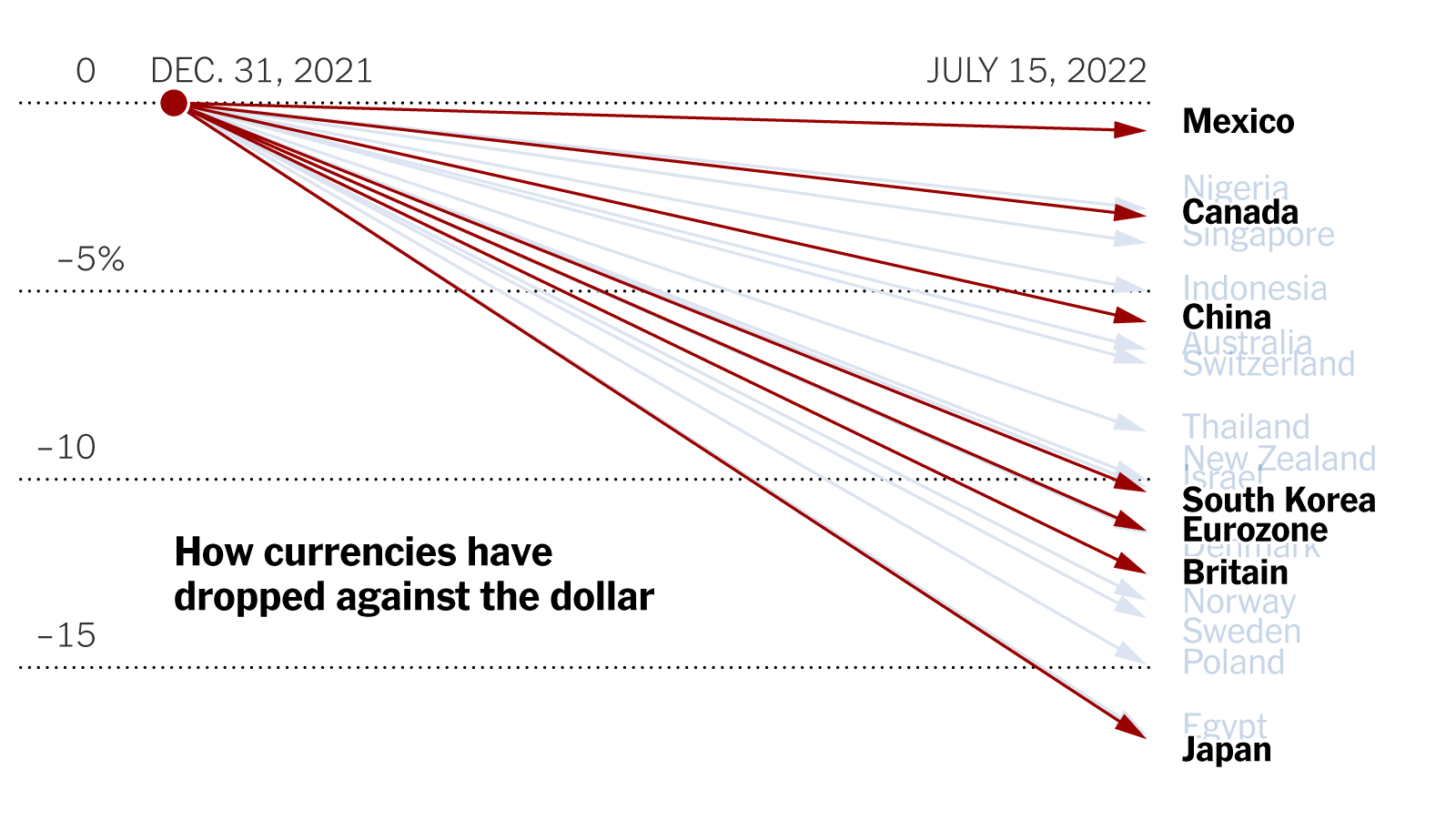
- The Eurozone and Japan: A weak euro and yen, while boosting exports, have been a major driver of inflation in the Eurozone and Japan by making their essential energy imports (paid in dollars) prohibitively expensive. The Bank of Japan’s prolonged battle to support the yen is a direct testament to the pressure exerted by the strong dollar.
- The UK: The UK’s inflation problem was significantly exacerbated by the pound’s weakness against the dollar in 2022, which increased the cost of its vast imports.
Part 3: The Double-Edged Sword – What a Strong Dollar Means for the USA
For the United States, the strong dollar narrative is not one of unadulterated victory. It presents a complex mix of benefits and drawbacks that have tangible effects on American businesses, consumers, and policymakers.
The Benefits (The “Exorbitant Privilege”)
- Tamed Imported Inflation: A strong dollar acts as a natural inflation dampener for the U.S. It makes imported goods—from Chinese consumer electronics and European automobiles to Colombian coffee and Italian wine—cheaper for American consumers and businesses. This has been a non-trivial factor in the Fed’s fight to bring inflation back to its 2% target.
- Increased Purchasing Power for Americans: American tourists abroad find their dollars going further. U.S. corporations looking to acquire foreign assets or companies find them cheaper, facilitating cross-border mergers and acquisitions.
- Capital Inflows and Cheaper Financing: The influx of foreign capital seeking safe returns keeps demand for U.S. government debt high. This helps to keep Treasury yields lower than they might otherwise be, reducing the federal government’s borrowing costs and keeping mortgage and corporate loan rates more manageable.
The Drawbacks (The “Exorbitant Burden”)
- The Multinational Earnings Drag: This is the most direct negative impact on Corporate America. U.S. multinational giants like Apple, Procter & Gamble, and Coca-Cola generate a substantial portion of their revenue overseas. When those revenues in euros, yen, or yuan are converted back into a strong dollar, they translate into fewer reported dollars on their income statements. This “earnings drag” has been a persistent theme in recent S&P 500 earnings seasons, often leading to downward revisions in profit forecasts and exerting a moderating force on the U.S. stock market.
- Hollowed Competitiveness: A strong dollar makes U.S. exports more expensive and less competitive in global markets. An American-made tractor, aircraft, or software license becomes pricier for foreign buyers compared to products from competitors in Europe or Japan. This hurts U.S. manufacturers, agricultural exporters, and tech firms, potentially widening the U.S. trade deficit and negatively impacting employment in export-oriented industries.
- The Fed’s Complicated Calculus: The strong dollar, by taming inflation, does some of the Fed’s work for it. However, it also poses a risk. If the global “squeeze” triggers a severe international recession, it will inevitably boomerang back to hurt the U.S. through reduced export demand and financial contagion. The Fed must therefore navigate a narrow path: raising rates enough to combat domestic inflation without triggering a global crisis that undermines the U.S. economy.
Read more: Introduction: Why the U.S. Dollar Matters More Than Ever
Part 4: The Future Trajectory and Long-Term Challenges
The question on every investor’s and policymaker’s mind is: How long can this last?
The Near-Term Outlook: Persistence
In the short to medium term, the dollar’s strength is likely to persist. The Fed has signaled that interest rates will remain “higher for longer” until it has conclusive evidence that inflation is defeated. Any new wave of global risk-off sentiment, driven by geopolitical flare-ups or a sharper-than-expected slowdown in China, will only add more fuel to the dollar’s safe-haven appeal.
The Peak Dollar Debate
However, many analysts believe the dollar may be nearing its peak. As the U.S. inflation cools and the Fed eventually pauses its tightening cycle, while other central banks continue to hike, the interest rate differential could narrow. This would remove a key pillar of the dollar’s strength.
The Long-Term Threat: De-Dollarization?
Beyond the business cycle, the current period of dollar dominance is fueling the most serious debate in decades about the long-term viability of the U.S. dollar’s reserve status. The use of financial sanctions as a foreign policy tool, particularly against Russia, has spooked other nations—including strategic competitors like China and neutral countries like India and Saudi Arabia.
The active pursuit of de-dollarization is underway, though its progress is often overstated.
- BRICS+ Initiatives: The expanded BRICS bloc is openly discussing a potential common currency and promoting trade in local currencies.
- China’s Renminbi Ambitions: China is aggressively promoting the use of the yuan in international trade and is building alternative financial infrastructure (like the Cross-Border Interbank Payment System, CIPS).
- Central Bank Diversification: Global central banks are slowly increasing their gold reserves and diversifying into other currencies, albeit from a very low base.
The Verdict: While a full-scale replacement of the dollar is unlikely for the foreseeable future—due to the depth of U.S. capital markets, the rule of law, and a lack of viable alternatives—the world is slowly moving toward a more multipolar currency system. The “exorbitant privilege” may not be revoked, but it could be diluted.
Conclusion: Navigating a World of America’s Own Making
The strong U.S. dollar is a testament to the underlying strength and perceived safety of the American economy. It provides real benefits to the U.S. in its fight against inflation and reinforces its central role in global finance. Yet, this strength comes at a cost. It acts as a silent tax on American exporters and multinational corporations, and it exports financial instability to the rest of the world, creating a vortex of debt and inflation that could ultimately circle back to harm U.S. interests.
For U.S. policymakers, the challenge is one of stewardship. Leveraging the dollar’s power responsibly, while being mindful of the global collateral damage, is crucial. For investors and business leaders, understanding this dynamic is key to navigating volatility and identifying opportunities. The era of dollar dominance is not over, but its consequences are becoming more pronounced, forcing the world, and America itself, to grapple with the heavy weight of the crown.
FAQ Section
Q1: Is a strong U.S. dollar good or bad for America?
It’s a double-edged sword. It’s good for American consumers because it makes imports cheaper and helps fight inflation. It’s bad for American companies that rely on exports or do significant business overseas, as their products become more expensive for foreign buyers and their overseas earnings are worth less when converted back to dollars.
Q2: Why does a strong dollar hurt other countries so much?
Most global trade and debt are denominated in U.S. dollars. A strong dollar makes it more expensive for other countries to import essential goods (like energy and food) and dramatically increases the burden of repaying their dollar-denominated debt, potentially triggering debt crises.
Q3: Who benefits the most from a strong dollar?
- American consumers and importers (cheaper goods and travel).
- The U.S. government (can borrow more cheaply due to high demand for Treasury bonds).
- Investors holding dollar-denominated assets.
Q4: Who suffers the most from a strong dollar?
- U.S. exporters and multinational corporations.
- Emerging market and developing countries with high levels of dollar-denominated debt.
- European and Japanese companies that see their earnings shrink when converted to dollars.
- Countries that are net importers of commodities (as their import bills soar).
Q5: What is “de-dollarization,” and is it a real threat to the U.S.?
De-dollarization is the process of reducing the world’s reliance on the U.S. dollar for international trade, finance, and as a reserve currency. It is a real long-term trend, accelerated by U.S. sanctions and geopolitical rivalry, primarily with China. However, it is a slow process. The dollar’s dominance is deeply entrenched, and there is currently no credible alternative that offers the same depth, liquidity, and stability. It is a threat to monitor, not an imminent reality.
Q6: What would cause the U.S. dollar to weaken?
The dollar would likely weaken if:
- The Federal Reserve begins cutting interest rates.
- The U.S. economy enters a recession while other economies remain resilient.
- A significant resolution to major geopolitical conflicts (e.g., in Ukraine or the Middle East) reduces safe-haven demand.
- Other major central banks (like the ECB) become more hawkish relative to the Fed.
About the Author: This analysis was compiled by our team of market and economic