For decades, the geopolitics of energy were defined by a simple, stark reality: the United States was the world’s largest importer of crude oil, its economy and foreign policy perpetually intertwined with the stability of volatile producing regions. The specter of the 1973 OPEC oil embargo loomed large in the American psyche, a constant reminder of national vulnerability. Today, that reality has been utterly inverted. The United States is not only energy independent but has emerged as the world’s largest producer of crude oil and natural gas, a net exporter of both, and a pivotal force reshaping the global energy landscape.
This transformation is not merely a statistical milestone; it is a geostrategic earthquake with profound implications for global economics, diplomacy, and security. The journey from a position of dependency to one of dominance is a story of technological ingenuity, market forces, and strategic policy shifts. This article will delve into the origins of the American energy renaissance, analyze its current impact on global markets, and explore the future challenges and opportunities as the U.S. cements its role as an energy superpower.
Part 1: The Genesis of a Revolution – How the U.S. Achieved Energy Independence
The path to energy independence was paved by a convergence of factors, but its core engine was a technological breakthrough: the perfection of hydraulic fracturing and horizontal drilling.
1.1 The Technological Marvel: Fracking and Horizontal Drilling
For years, vast quantities of oil and natural gas were known to be trapped in dense shale rock formations across the United States—from the Permian Basin in Texas and New Mexico to the Bakken in North Dakota and the Marcellus in Pennsylvania. Conventional drilling methods could not economically liberate these resources.
- Hydraulic Fracturing (“Fracking”): This process involves injecting a high-pressure mixture of water, sand, and chemicals deep underground to create tiny fractures in the shale rock, allowing the trapped hydrocarbons to flow.
- Horizontal Drilling: This technique involves drilling vertically to a certain depth and then turning the drill bit to bore horizontally through the shale layer, sometimes for miles. This exposes a much larger surface area of the rock to the wellbore, dramatically increasing production.
The marriage of these two technologies in the early 2000s, led by tenacious independent wildcatters, unlocked previously inaccessible reserves. The “shale boom” had begun, turning the U.S. into the “Saudi Arabia of shale gas” and later, a crude oil powerhouse.
1.2 The Policy and Market Environment
Technology alone was not sufficient. A supportive policy and market landscape provided the necessary catalyst.
- The Crude Oil Export Ban Lift (2015): A pivotal moment came in December 2015 when Congress, in a bipartisan move, lifted the 40-year-old ban on exporting U.S. crude oil. This ban, a relic of the 1970s energy crises, had become a straitjacket on the burgeoning shale industry. Its removal opened the global market to American producers, allowing them to compete internationally and fetch higher world prices.
- Market Dynamics: Periods of high global oil prices, particularly in the early 2010s, provided the financial incentive for massive capital investment in shale exploration and production. The industry’s unique “manufacturing” model, characterized by rapid drilling and completion times, allowed it to respond to price signals with an agility that traditional mega-projects in Saudi Arabia or deepwater Brazil could never match.
1.3 The Rise of LNG Export Infrastructure
For natural gas, the path to export markets required a different kind of transformation. Natural gas must be super-cooled to -260°F (-162°C) to become a liquid, reducing its volume by 600 times, making it economical to transport via specialized tankers. This is known as Liquefied Natural Gas (LNG).
The U.S. began a monumental build-out of LNG export facilities, primarily along the Gulf Coast. The first major terminal, Sabine Pass in Louisiana, began operations in 2016. Since then, the U.S. has become the world’s largest LNG exporter, with capacity continuing to expand. This infrastructure is the physical bridge connecting America’s abundant gas fields to the global market.
Part 2: The New Arbiter: How U.S. Exports Reshape Global Markets
The influx of American oil and gas has fundamentally altered the dynamics of global energy trade, challenging old hierarchies and creating new dependencies.
2.1 Challenging OPEC’s Dominance
For over 50 years, the Organization of the Petroleum Exporting Countries (OPEC), and later OPEC+, has acted as the “swing producer” in the global oil market, attempting to manage prices by coordinating production cuts or increases. The rise of the U.S. shale industry has disrupted this model.
The U.S., as a market-driven producer, does not coordinate its output with OPEC. Instead, it acts as a “swing supplier.” When OPEC+ cuts production to raise prices, it creates a vacuum that higher-cost U.S. shale producers are often quick to fill. This has effectively placed a ceiling on oil prices, limiting OPEC’s ability to exert extreme pressure on the global economy. The global market now looks to two poles for its supply stability: the state-managed production of OPEC+ and the market-responsive output of the U.S. shale patch.
2.2 Natural Gas: A Geopolitical Tool and Market Stabilizer
The impact of U.S. LNG is perhaps even more profound. For years, many European nations were heavily dependent on pipeline gas from Russia, giving Moscow significant political and economic leverage. The war in Ukraine laid bare the risks of this dependency.
- Diversifying European Energy Supply: U.S. LNG has been instrumental in helping Europe wean itself off Russian gas. In 2022 and 2023, American exporters rerouted cargoes to Europe, helping to fill storage facilities and avert an energy catastrophe. This has not only been an economic boon for the U.S. but a strategic victory, strengthening transatlantic ties and reducing Russia’s coercive power.
- Creating a More Liquid and Flexible Global Gas Market: Traditionally, natural gas was traded through long-term, oil-indexed contracts via rigid pipeline networks. U.S. LNG is predominantly sold on a more flexible, hub-priced basis. This has fostered the development of a truly global, spot-based market for gas, similar to oil, giving consumers more choice and suppliers more flexibility.
2.3 The “Henry Hub” Benchmark
The U.S. benchmark for natural gas prices, known as Henry Hub, is increasingly becoming a global reference price. As more LNG is traded based on Henry Hub rather than being tied to the price of oil, it creates a more transparent and efficient market, further cementing the U.S.’s central role.
Part 3: The Domestic and Global Implications: A Double-Edged Sword
This newfound energy prowess brings immense benefits but also significant challenges, both at home and abroad.
3.1 Domestic Economic and Security Benefits
- Economic Stimulus: The shale boom has created millions of jobs, directly and indirectly, from roughnecks in the oil fields to engineers, pipeline workers, and port operators. It has spurred massive investments in manufacturing, particularly in energy-intensive industries like petrochemicals, which now enjoy a significant cost advantage.
- Enhanced National Security: Energy independence does not mean the U.S. is insulated from global oil price shocks, but it does provide a greater cushion. The nation is no longer held hostage by potential supply disruptions in distant regions. This affords U.S. foreign policy greater flexibility and reduces the need for military intervention solely to protect energy supply lines.
- Consumer Benefits: Abundant natural gas has driven down electricity and heating costs for American households and businesses. It has also been the primary driver behind the reduction of U.S. carbon emissions in the power sector, as cheap gas has displaced coal-fired generation.
3.2 Environmental and Geopolitical Challenges
- The Environmental Paradox: The shale revolution is central to a profound contradiction. On one hand, the surge in natural gas has helped the U.S. lower its CO2 emissions by displacing coal. On the other, it perpetuates a fossil-fuel-based economy. Concerns around methane leaks (a potent greenhouse gas), water contamination, seismic activity, and local air pollution from fracking operations remain serious points of contention.
- The Global Climate Imperative: As the world’s largest producer and exporter of oil and gas, the U.S. faces intense scrutiny regarding its role in global climate change. While American LNG can help other countries like China and India reduce their reliance on dirtier coal, it also locks in global demand for fossil fuels for decades. The U.S. is simultaneously leading the charge in renewable energy deployment while leading the world in hydrocarbon production—a delicate and often contradictory balancing act.
- Market Volatility: The very agility of the shale industry—its ability to ramp production up and down quickly—can contribute to price volatility. A rapid increase in U.S. production can lead to global gluts and price collapses, as seen in 2014-2016 and 2020, which can destabilize other producing nations and strain the U.S. industry itself, leading to bankruptcies and job losses.
Read more: Introduction: Why the U.S. Dollar Matters More Than Ever
Part 4: The Road Ahead: Navigating the Energy Transition
The future of U.S. energy influence will be shaped by its ability to navigate the complex transition to a lower-carbon future.
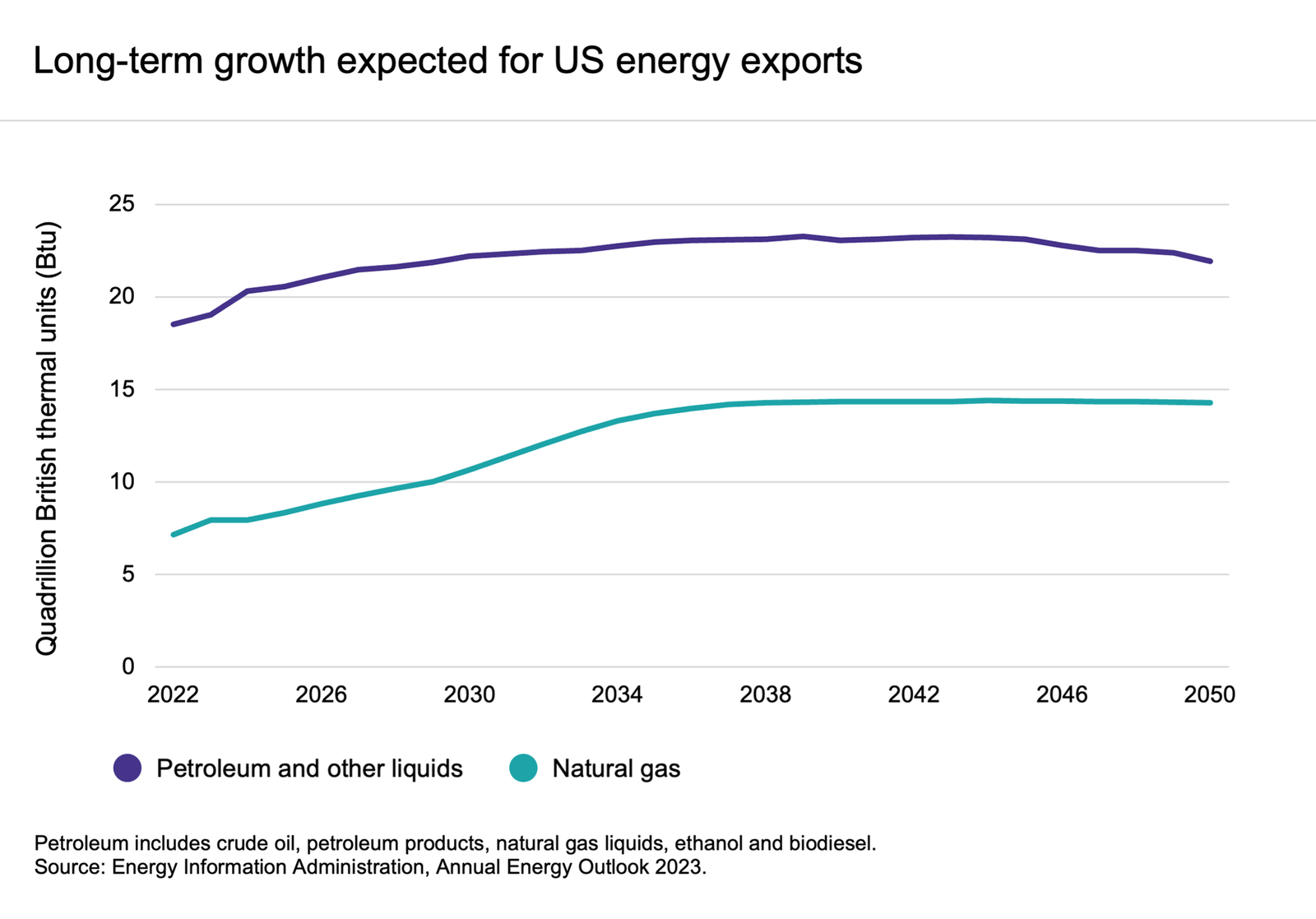
- Continued Dominance in the Near Term: The Energy Information Administration (EIA) projects that U.S. oil and gas production will continue to grow, reaching new record highs in the coming years. The infrastructure for exports is still expanding, meaning the U.S.’s global market share is set to increase.
- The Investment Dilemma: The shale industry faces pressure from investors to prioritize financial discipline and free cash flow over relentless production growth. This could moderate the pace of future output increases but make the industry more resilient.
- The Green Energy Competition: The U.S. is in a global race to dominate the clean energy technologies of the future, such as hydrogen, carbon capture, advanced batteries, and critical mineral processing. The Inflation Reduction Act represents a massive strategic investment in this arena. The ultimate test will be whether the U.S. can leverage its energy expertise and industrial capacity to become a leader in the next energy era, not just the current one.
Conclusion: An Unprecedented Position of Power and Responsibility
The United States has undergone one of the most dramatic strategic reversals in modern economic history. From a nation defined by energy scarcity and vulnerability, it has become the world’s energy titan. This status confers enormous power: it bolsters the American economy, provides leverage in diplomatic negotiations, and offers a lifeline to allies.
Yet, with this power comes profound responsibility. How the U.S. manages its hydrocarbon wealth while accelerating its own energy transition and supporting global climate goals will define its leadership in the 21st century. The era of American energy influence is not a temporary boom; it is a new, enduring reality of the global order. The world now looks to the wells of Texas and the LNG terminals of Louisiana as much as it once looked to the oil fields of the Arabian Gulf, marking a historic shift in the balance of global power.
Read more: Backtesting Your Swing Trading Strategy: How to Validate Ideas Before Risking Real Money
Frequently Asked Questions (FAQ)
Q1: What does “energy independence” actually mean? Does it mean the U.S. doesn’t import any oil?
A: This is a common misconception. “Energy independence” is an economic and strategic concept, not an isolationist one. It means that the total energy produced in the U.S. is greater than the total energy consumed. Crucially, the U.S. still imports crude oil, particularly heavy grades that its refineries are optimized to process, and it exports light sweet crude from shale plays. It is a net exporter—meaning its exports exceed its imports—which is the key indicator of independence. This status provides a buffer against global supply shocks.
Q2: Is the U.S. shale boom sustainable, or will the wells run dry quickly?
A: Shale wells are known for high initial production that declines rapidly, unlike conventional wells. However, the sustainability of the boom is not about individual wells but about the vast resource base and continued technological innovation. The U.S. has immense proven reserves. The challenge is less about running out of oil and gas and more about the economics: accessing it profitably, managing water resources, and navigating investor demands for returns versus growth. The industry has consistently improved its techniques, extracting more oil and gas from each well over time.
Q3: How does the U.S. being an energy exporter help American consumers?
A: The benefits are significant, though sometimes indirect:
- Lower Natural Gas Prices: Abundant domestic supply keeps U.S. natural gas prices among the lowest in the developed world, reducing heating and electricity bills.
- Economic Growth and Jobs: The industry supports millions of high-paying jobs and stimulates investment in manufacturing and related sectors.
- National Security: A stronger, more resilient economy less vulnerable to global energy price shocks ultimately benefits every citizen through greater economic stability.
Q4: With the U.S. exporting so much LNG, won’t that drive up prices at home?
A: This is a valid concern. Connecting the U.S. gas market to the higher-priced global market through LNG exports does create upward pressure on domestic prices. However, the massive scale of U.S. gas production has so far largely absorbed this increased demand without catastrophic price spikes. The Henry Hub price remains a fraction of prices in Europe or Asia. Market dynamics, regulatory oversight, and the continued growth of production are key to managing this balance.
Q5: Can the U.S. maintain its status as a top energy exporter while meeting its climate goals?
A: This is the central dilemma of the current energy era. The path involves a multi-pronged approach:
- Reducing Methane Emissions: Implementing strict regulations and advanced technology to capture methane leaks from oil and gas operations.
- Carbon Capture, Utilization, and Storage (CCUS): Deploying technology to capture CO2 emissions from industrial sources and power plants, preventing them from entering the atmosphere.
- Accelerating Renewables: Continuing the rapid deployment of wind, solar, and other zero-carbon technologies to decarbonize the power grid.
- Global Gas for Coal Displacement: Leveraging U.S. LNG to help emerging economies transition away from coal, which emits roughly twice the CO2 of natural gas per unit of electricity.