For generations, the success of a farm was measured by the strength of its draft animals, the fertility of its soil, and the resilience of the farmer facing the whims of nature. The tools were mechanical—the tractor, the combine, the center-pivot irrigation system. These innovations brought scale and power, transforming the American prairie into the world’s breadbasket.
Today, a new, quieter revolution is unfolding across the heartland. It is not powered by diesel, but by data. The most valuable piece of equipment on a modern farm is increasingly not the tractor itself, but the array of sensors, satellites, and algorithms that guide it. We are witnessing the rise of the Data-Driven Farm, a sophisticated agricultural enterprise where every decision—from the subsoil to the supply chain—is informed, optimized, and validated by information technology.
This transformation, often called the “Fourth Agricultural Revolution” or “Agriculture 4.0,” is driven by the convergence of connectivity, robotics, biotechnology, and data analytics. For an industry grappling with the immense pressures of climate volatility, resource scarcity, and global demand, agritech is not merely an incremental improvement; it is a paradigm shift essential for sustainability and survival.
This article provides a deep analysis of the agritech revolution in the United States. We will explore the key technologies fueling this change, quantify their impact on productivity and sustainability, examine the economic and social implications for the agricultural community, and confront the significant challenges that threaten to create a new “digital divide” in rural America.
Part 1: The Technological Toolkit – Deconstructing the Data-Driven Farm
The data-driven farm operates on a continuous cycle of measurement, analysis, and action. This is enabled by a stack of interconnected technologies.
1.1 The Sensing Layer: The Farm’s Digital Nervous System
Before data can be analyzed, it must be collected. A myriad of devices now acts as the farm’s senses, gathering data at an unprecedented scale and resolution.
- Satellites and Drones (Eyes in the Sky): Multispectral and hyperspectral satellites provide regular, macro-level views of crop health, water stress, and biomass. Complementing them, Unmanned Aerial Vehicles (UAVs or drones) offer high-resolution, on-demand imagery, capable of identifying pest outbreaks, nutrient deficiencies, or drainage issues long before they are visible to the human eye.
- In-Field Sensors (The Ground Truth): A network of inexpensive, connected sensors planted throughout fields provides real-time, micro-level data on soil moisture, temperature, nutrient levels (e.g., nitrogen), and salinity. This “internet of things” (IoT) for agriculture eliminates guesswork, providing a precise picture of the field’s micro-environments.
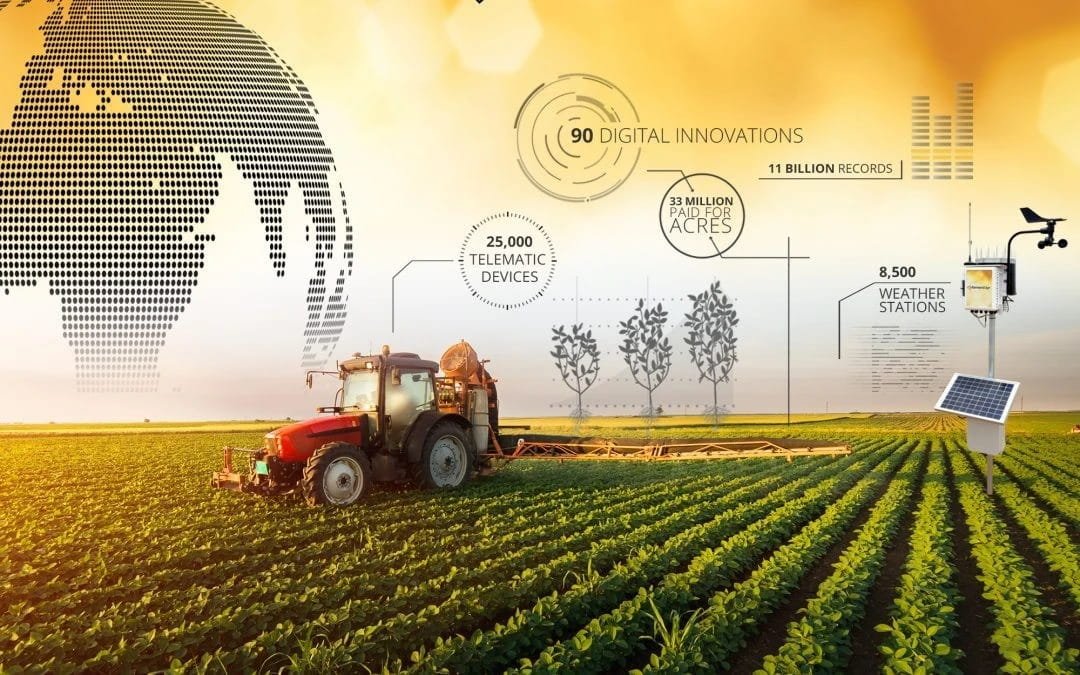
- Equipment Telematics (The Machines That Talk): Modern tractors, combines, and sprayers are rolling data centers. They continuously log data on fuel consumption, engine performance, implement status, and, crucially, yield and as-applied inputs. This machine-generated data is the bedrock of precision execution.
1.2 The Analytical Brain: From Raw Data to Actionable Intelligence
Raw data is meaningless without interpretation. This is where the true power of agritech emerges, through sophisticated software platforms generally known as Farm Management Information Systems (FMIS) or digital agronomy platforms.
- Data Integration and Visualization: Platforms from companies like John Deere (Operations Center), Climate FieldView, and Trimble Ag Software pull in data from all sources—satellites, sensors, machines—and consolidate it into a single, unified view. A farmer can see a yield map from last harvest overlaid with real-time soil moisture data and a drone image showing a specific area of stress.
- Predictive Analytics and Modeling: Using historical data, weather forecasts, and crop growth models, these platforms can predict outcomes. They can forecast yield potential, model the impact of a coming frost or heatwave, and predict the optimal window for planting or harvesting.
- Prescriptive Analytics: The Rise of the Algorithmic Agronomist: This is the most advanced stage. The system doesn’t just predict; it prescribes. It can generate a variable rate seeding map, telling the planter to plant more densely in high-productivity zones and less in poor ones. It can create a variable rate prescription for fertilizer, applying exactly what is needed in each square meter of the field, minimizing waste and environmental runoff.
1.3 The Automated Hand: Robotics and Precision Actuation
Intelligence is useless without the ability to act. The final layer of the agritech stack is the machinery that carries out the digital plan with superhuman precision.
- Precision Guidance and Auto-Steer: Once a novelty, GPS-guided auto-steer is now standard on most new equipment. It eliminates pass-to-pass overlap, reducing input waste (fuel, seed, fertilizer) by 5-10% and allowing operation in low-visibility conditions.
- Variable Rate Technology (VRT): This technology allows a fertilizer spreader or sprayer to automatically adjust its application rate on the fly, following the digital prescription map generated by the FMIS. This is the physical manifestation of precision agriculture.
- Smart Implements: Advanced implements can now make real-time adjustments. For example, “see-and-spray” weed control systems use computer vision to identify individual weeds and spray herbicide only on them, reducing chemical use by over 90% compared to broadcast spraying.
- Agricultural Robots (AgBots): While still in earlier stages of adoption, autonomous robots are being developed for highly specific, labor-intensive tasks. These include robotic weeders, strawberry pickers, and pruning machines, which promise to address chronic labor shortages and perform tasks with minimal soil compaction.
Part 2: The Impact – Quantifying the Benefits of the Digital Shift
The adoption of these technologies is not for its own sake; it delivers tangible, measurable benefits across three critical areas: productivity, sustainability, and economics.
2.1 Enhancing Productivity and Yield Stability
The primary goal is to produce more food, more reliably.
- Optimizing Inputs for Maximum Output: By placing the right input (seed, water, fertilizer) in the right place, at the right time, and in the right amount, farmers can push their yields closer to the genetic potential of the seed. A 5-10% yield increase, once elusive, is now achievable through data-driven management.
- Loss Prevention: Early detection of disease, pests, or water stress through remote sensing allows for targeted interventions, saving a crop that might otherwise have been significantly damaged. This enhances yield stability from season to season.
2.2 Advancing Environmental and Economic Sustainability
This is where agritech makes one of its most profound contributions, aligning economic interests with ecological responsibility.
- The Resource Efficiency Dividend:
- Water: Smart irrigation systems, guided by soil moisture sensors and evapotranspiration data, can reduce water usage by 20-30%. In aquifer-stressed regions like the American West, this is not just cost-saving; it is existential.
- Fertilizers and Chemicals: Variable rate technology and targeted spraying dramatically reduce the volume of fertilizers and pesticides applied. This lowers costs for the farmer and significantly mitigates agricultural runoff, a major source of water pollution in watersheds like the Mississippi Basin and the Gulf of Mexico.
- Soil Health and Carbon Sequestration: Precision agriculture promotes soil health. Less compaction from optimized field traffic, coupled with cover cropping and no-till practices guided by data, improves soil organic matter. This not only boosts long-term productivity but also positions agriculture as a potential carbon sink, opening up new revenue streams via carbon credit markets.
Read more : The AI Arms Race: How US Tech Giants are Consolidating Power on the Global Stage
2.3 Improving Operational Efficiency and Risk Management
Farming is a business of immense risk. Data is a powerful tool for de-risking operations.
- Labor and Fuel Savings: Auto-guidance reduces operator fatigue and allows one person to manage more acres. Optimized field paths and reduced overlap save significant amounts of fuel.
- Financial Planning and Marketing: Detailed yield data and production costs allow for more accurate financial forecasting. Understanding the true cost of production on a per-acre or even per-zone basis empowers farmers to make smarter marketing decisions for their crops.
- Access to Capital and Insurance: Lenders and insurers are increasingly looking at farm data to assess risk. A farmer with a proven track record of high-efficiency, data-driven practices may secure better loan rates or insurance premiums.
Part 3: The Human Element – Social and Economic Repercussions
No technological shift is without its social consequences. The rise of the data-driven farm is reshaping the rural landscape and the very profession of farming.
3.1 The Changing Role of the Farmer: From Laborer to Data Manager
The iconic image of the farmer with weathered hands on the plow is evolving. The modern farmer is increasingly a technology integrator and data analyst. Their success depends on their ability to interpret data dashboards, manage software subscriptions, and make strategic decisions based on algorithmic recommendations. This requires a new set of skills, shifting the nature of agricultural work from purely physical to highly cognitive.
3.2 The Threat of a Digital Divide
The potential for agritech to improve efficiency is undeniable, but its benefits are not automatically distributed equally.
- The Cost Barrier: Advanced precision agriculture equipment and software subscriptions represent a significant capital investment. Large, well-capitalized farms are best positioned to adopt these technologies, reaping the benefits of lower per-unit costs. This can create a competitive advantage that accelerates the trend of farm consolidation, potentially squeezing out small and mid-sized operations.
- The Connectivity Chasm: The entire agritech stack relies on a robust, high-speed internet connection. Vast swathes of rural America still lack adequate broadband access. A farm without connectivity cannot utilize real-time data streaming, cloud-based analytics, or over-the-air software updates, putting it at a severe disadvantage. Bridging this “digital divide” is a critical infrastructure challenge.
3.3 Data Ownership and Privacy: The New Farmland
The data generated by a farm—the yield maps, soil analyses, input records—is immensely valuable. It is, in essence, the digital transcript of the farm’s operational DNA. This raises critical questions:
- Who owns the data? The farmer? The equipment manufacturer? The software provider?
- How is it being used? Could aggregated, anonymized data be sold to commodities traders, giving them an informational advantage over the farmers who produced it?
- How is it protected? A farm’s data is a strategic asset that must be secured from cyber threats.
The industry has moved towards establishing the Core Principles of Farm Data (emphasizing ownership, transparency, and portability), but vigilance and clear contractual agreements are essential for farmers to maintain control of their digital destiny.
Read more : The Great Divergence: Can the US Economy Stay Decoupled as Europe and China Slow?
Part 4: The Future Harvest – Emerging Trends and the Road Ahead
The agritech revolution is still accelerating. Several emerging trends promise to deepen the integration of data and biology.
- Hyper-Localized Management: We are moving from field-level to square-meter-level management. AI and machine learning will analyze complex interactions between soil, weather, and plant genetics to generate hyper-specific management zones and prescriptions.
- Gene-Editing and Predictive Biology: Tools like CRISPR are allowing for precise genetic edits. When combined with genomic data and predictive analytics, this could lead to the design of custom crop varieties tailored for specific micro-climates or resistance to emerging pests.
- The Digitized Food Supply Chain: Blockchain and other traceability technologies are extending data-driven transparency from the field to the fork. Consumers will be able to scan a QR code on a product and see its entire journey, verifying claims about sustainability, organic status, and origin.
- AI-Powered Pest and Disease Prediction: AI models are being trained on vast image libraries of plant diseases. Soon, a farmer will be able to take a picture of a diseased leaf with a smartphone and instantly get a diagnosis and a targeted treatment plan.
Conclusion: Sowing the Seeds of a Resilient Future
The transition to the data-driven farm is as profound as the original mechanization of agriculture. It presents a pathway to solving the central challenge of the 21st century: how to nourish a growing population while stewarding finite natural resources.
The benefits are clear—enhanced productivity, remarkable gains in sustainability, and improved resilience for farming businesses. However, this future is not pre-ordained. Its equitable realization depends on confronting key challenges head-on: ensuring affordable access to technology, guaranteeing universal rural broadband, establishing ironclad data rights for farmers, and supporting the agricultural workforce through this technological transition.
The American farmer has always been an innovator. The data-driven farm is the latest chapter in this story. By harnessing the power of data, farmers are not abandoning their traditional wisdom; they are augmenting it with powerful new tools to ensure that agriculture remains productive, profitable, and sustainable for generations to come. The seeds of the future have been planted, and they are being nurtured with bytes as well as water.
Frequently Asked Questions (FAQ)
1. Is agritech only for massive, corporate farms?
While large farms were early adopters due to economies of scale, the technology is rapidly democratizing. Many software-as-a-service (SaaS) platforms offer subscription models accessible to mid-sized farms. Furthermore, the proliferation of smartphones and lower-cost sensor and drone technology is putting basic precision agriculture tools within reach of a broader range of producers. The key is finding the right entry point that offers a return on investment for a specific operation.
2. What is the biggest barrier to adoption for most farmers?
Beyond the initial cost, the single largest barrier is often complexity and trust. Farmers are rightfully skeptical of “black box” algorithms that make recommendations without clear explanation. The most successful agritech companies are those that focus on user-friendly design and provide agronomic support to help farmers understand the “why” behind the data, building trust through transparency and demonstrated results.
3. I’m concerned about data privacy. If I use these platforms, who owns my data?
This is a critical question you must ask any technology provider before signing a contract. Reputable companies have adopted transparency agreements and data privacy policies that clearly state you own your data. These agreements should specify that the provider cannot sell your individual, identifiable data without your permission. Always read the terms of service and look for providers who are signatories to industry-wide data privacy principles.
4. How does agritech contribute to environmental sustainability?
The contribution is multi-faceted:
- Precision Input Application: Dramatically reduces over-application of fertilizers and pesticides, preventing nutrient runoff into waterways.
- Efficient Water Use: Smart irrigation conserves water, a critical resource in many regions.
- Soil Conservation: Precision guidance and auto-steer reduce soil compaction; data can promote practices like cover cropping that improve soil health.
- Lower Carbon Footprint: Fuel savings from optimized field operations and reduced passes directly lower greenhouse gas emissions.
5. Will robots and AI eventually replace human farmers?
It is highly unlikely that AI and robots will completely replace farmers. Instead, they are augmenting human intelligence and labor. The role of the farmer is evolving from manual operator to strategic manager and decision-maker. AI can handle data crunching and repetitive tasks, but it cannot replicate the farmer’s deep, contextual knowledge of their land, their intuition honed by experience, or their ability to manage the complex business and human elements of a farm. The future farm will likely have fewer laborers but will require more skilled managers.