The foreign exchange (forex) market is a colossal, 24-hour financial arena where currencies are traded. With a daily trading volume exceeding $6 trillion, it is, without question, the world’s most liquid market. This liquidity promises ease of entry and exit, tight spreads, and the potential for profit from the slightest fluctuations in global economies. For the aspiring US trader, the siren song of forex is powerful—leverage offered by brokers can magnify gains from small moves, creating visions of significant returns.
However, this very leverage is a double-edged sword. It amplifies losses with the same ferocity it amplifies gains. The harsh reality, often obscured by flashy marketing and get-rich-quick schemes, is that a vast majority of retail traders lose money. The primary cause of this failure is not a lack of a “winning strategy” or an inability to predict market direction. It is a profound and fundamental failure in risk management.
This article is not about finding a secret indicator or a foolproof entry technique. It is about the unglamorous, disciplined, and absolutely critical foundation upon which all successful trading careers are built: the science and art of protecting your capital. We will delve deep into the two most potent tools in a trader’s risk-management arsenal: Position Sizing and Stop-Loss Rules. For the US trader, navigating a regulated environment with unique rules, mastering these concepts is not just advisable—it is imperative for survival and long-term success.
Part 1: The Bedrock of Trading Survival – The Psychology of Risk
Before we crunch a single number or place a single trade, we must address the human element. The greatest risk management system in the world is useless without the psychological fortitude to execute it consistently.
The Enemies Within: Fear and Greed
- The Impulse to “Let It Ride”: You’re in a profitable trade, and your profit target is near. Suddenly, greed whispers, “It’s going higher! Just remove the target and let it run!” While trailing stops have their place, arbitrarily moving a profit target against your plan often ends with the trade reversing and turning a winner into a loser.
- The Refusal to Accept Being Wrong: A trade moves against you, approaching your stop-loss. The instinct is to remove the stop-loss because “it’s bound to come back.” This is the most dangerous mistake a trader can make. It transforms a defined, small loss into a potential account-destroying catastrophe. The market has no mercy for those who cannot admit they are wrong.
- Revenge Trading: After a loss, the emotional urge to “win it back immediately” is overpowering. This leads to jumping into a new trade without a signal, increasing position size irrationally, and ignoring risk parameters. This spiral is a direct path to ruin.
Cultivating a Professional Mindset:
Successful traders view trading as a probability business, not a prophecy. They understand that:
- Losses are Inevitable. Even the best strategies have losing streaks. A losing trade is not a failure; it is a cost of doing business.
- The Goal is Long-Term Consistency. They focus on the process of making high-probability decisions with solid risk/reward ratios, not on the outcome of any single trade.
- They Trade with Capital They Can Afford to Lose. This removes the life-or-death pressure that leads to emotional decision-making.
With this psychological framework in place, we can now build the technical systems that support it.
Part 2: The Unforgiving Math – Why Risk Management is Non-Negotiable
To understand why position sizing and stop-losses are so critical, you must first understand the mathematics of loss.
The Table of Financial Recovery:
| Percentage Loss | Percentage Gain Required to Break Even |
|---|---|
| 10% | 11.1% |
| 20% | 25.0% |
| 30% | 42.9% |
| 40% | 66.7% |
| 50% | 100.0% |
| 60% | 150.0% |
| 70% | 233.3% |
| 75% | 300.0% |
This table is a stark warning. A 50% drawdown on your account requires a 100% return just to get back to breakeven. This is an incredibly difficult task. The primary goal of risk management is to prevent deep drawdowns, ensuring that a string of losses does not cripple your ability to recover.
The “1% Rule” and Its Variations:
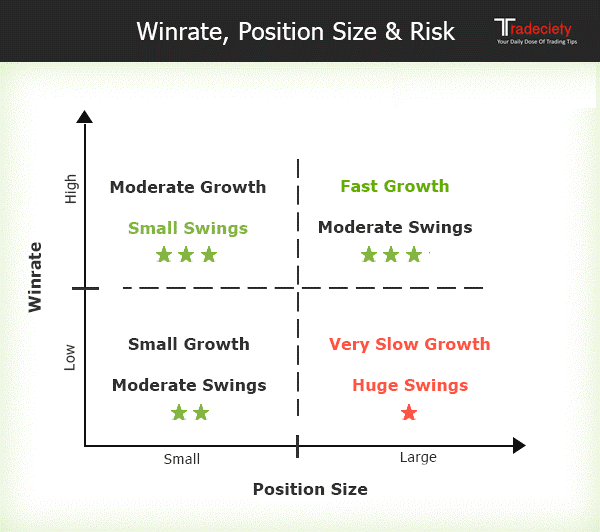
A cornerstone of prudent trading is the 1% Rule. This rule states that you should never risk more than 1% of your total account equity on any single trade.
- Account Size: $10,000
- Max Risk per Trade: 1% = $100
This means that if your trading system triggers 10 consecutive losses, you will only be down 10% of your account—a manageable drawdown from which to recover. For beginners, a 0.5% risk rule is even more conservative and advisable. More experienced traders with proven, robust systems may occasionally risk 1.5% or 2%, but going beyond this dramatically increases the probability of a catastrophic blow-up.
The 1% Rule is your first layer of defense. The next step is to determine how to risk that 1%, which brings us to the core of this article: position sizing.
Part 3: Position Sizing – The Engine of Risk Control
Position sizing is the process of determining how many units or lots of a currency pair to trade, based on your predefined risk tolerance (the 1% Rule) and the specific parameters of the trade.
It is the critical link between your abstract risk percentage and the concrete reality of the market. Getting this calculation wrong renders your stop-loss and risk percentage meaningless.
The Position Sizing Formula
The universal formula for calculating your position size is:
Position Size = (Account Equity × Risk per Trade %) / (Stop-Loss in Pips × Pip Value)
Let’s break down each component with a practical example.
Scenario:
- Account Balance (Equity): $10,000
- Risk per Trade: 1% ($100)
- Currency Pair: EUR/USD
- Trade Setup: You plan to buy EUR/USD at 1.0750, with a stop-loss at 1.0720.
- Pip Value: For a standard lot (100,000 units), 1 pip = $10. For a mini lot (10,000 units), 1 pip = $1. For a micro lot (1,000 units), 1 pip = $0.10.
Step 1: Calculate the Stop-Loss in Pips
Entry Price: 1.0750
Stop-Loss Price: 1.0720
Difference: 1.0750 – 1.0720 = 0.0030, which is 30 pips.
Step 2: Calculate the Maximum Capital at Risk
Account Equity × Risk % = $10,000 × 0.01 = $100
Step 3: Calculate the Pip Value Risk
We know we can afford to lose $100 over a 30-pip move.
Dollar Risk / Stop-Loss Pips = $100 / 30 pips = $3.33 per pip
Step 4: Determine the Lot Size
Since 1 micro lot (1,000 units) has a pip value of ~$0.10 (for EUR/USD):
$3.33 per pip / $0.10 per pip per micro lot = 33.3 micro lots
In practice, you would round down to 33 micro lots (or 0.33 mini lots, or 0.033 standard lots).
By performing this calculation, you have precisely calibrated your trade so that if price hits your stop-loss at 1.0720, you will lose exactly $100, which is 1% of your account. The trade is now defined by its risk, not by its potential profit.
Advanced Position Sizing: The Fixed Fractional Method
The method described above is a form of fixed fractional trading, where your risk is a fixed fraction of your current equity. Its most powerful feature is that it naturally scales your position size as your account grows or shrinks.
- If your account grows to $15,000, your 1% risk becomes $150, and your position sizes will automatically become larger, accelerating growth.
- If your account shrinks to $9,000, your 1% risk becomes $90, and your position sizes become smaller, preserving capital during a drawdown.
This built-in “money management” is what allows for exponential growth while protecting against ruin.
Part 4: The Art and Science of the Stop-Loss Order
A stop-loss order is a pre-set instruction to your broker to automatically close a trade at a specific price level to limit your loss. It is the physical manifestation of your risk tolerance on a chart.
Why a Stop-Loss is Mandatory, Not Optional
- It Enforces Discipline: It removes the emotional burden of manually closing a losing trade.
- It Defines Your Risk: As we saw in the position sizing section, the stop-loss is the key variable that allows you to calculate your lot size.
- It Protects Your Capital: It ensures that no single trade or black swan event can cause catastrophic damage to your account.
Techniques for Placing a Strategic Stop-Loss
A common mistake is placing a stop-loss arbitrarily, based on how much money one is willing to lose. Instead, your stop-loss should be determined by market structure. The market doesn’t care if you lose $100; it cares about support, resistance, and volatility.
1. The Technical / Structural Stop:
This is the most respected method. Place your stop-loss beyond a key level of market structure.
- For a Long Trade: Place your stop-loss below a recent significant swing low, a key support zone, or a major trendline.
- For a Short Trade: Place your stop-loss above a recent significant swing high, a key resistance zone, or a major trendline.
- Rationale: If price breaks through this level, the rationale for your trade (e.g., “the support will hold”) is invalidated. The market is telling you your thesis was wrong.
2. The Volatility-Based Stop (ATR):
The Average True Range (ATR) indicator measures the average movement of a currency pair over a specific period. Using it to set stops accounts for the inherent “noise” in the market.
- Method: If the 14-period ATR on the daily chart is 0.0070 (70 pips), you might place your stop-loss at 1.5 x ATR (105 pips) away from your entry. This prevents your stop from being taken out by normal, random market volatility that has nothing to do with your trade’s validity.
3. The Percentage Stop:
While less sophisticated, this method involves placing a stop a fixed percentage away from your entry (e.g., 2% below your buy price). Its weakness is that it ignores market structure, but it’s better than no stop at all.
What to Avoid:
- “Mental Stops”: The promise to yourself to close the trade if it hits a certain level. In a fast-moving market or during a moment of panic, this discipline often evaporates.
- Placing Stops Too Tight: Placing a stop-loss just a few pips away from entry to “minimize risk” often leads to being stopped out by market noise before the trade has room to develop. Your stop must be wide enough to be logical within the context of the pair’s volatility.
Part 5: The Synergy – Integrating Position Sizing and Stop-Losses
The magic of professional risk management happens when position sizing and stop-losses work in concert. Let’s walk through a complete trade example.
Trader Profile:
- US-based trader, Account: $20,000
- Risk Tolerance: 1% per trade ($200)
- Strategy: Swing trading based on daily chart structure.
Trade Identification:
- Pair: GBP/USD
- Setup: Bullish bounce off key support. Buy limit order at 1.2600.
- Stop-Loss: The recent significant swing low is at 1.2550. Placing the stop at 1.2545 (5 pips below the low) provides a buffer. Stop-Loss Distance = 55 pips.
- Profit Target: The next major resistance level is at 1.2750, providing a 150-pip potential reward.
Trade Analysis & Execution:
- Risk/Reward Ratio: 150 pip reward / 55 pip risk = 2.72 : 1. This is an excellent R:R, meaning the potential profit is over 2.7 times the potential loss. The trade is valid from a risk perspective.
- Position Sizing Calculation:
- Capital at Risk: $200
- Stop-Loss in Pips: 55 pips
- Pip Value Required: $200 / 55 pips = ~$3.63 per pip
- For GBP/USD, 1 micro lot (1,000 units) has a pip value of ~$0.10.
- Position Size: $3.63 / $0.10 = 36.3 micro lots (round down to 36 micro lots or 0.36 mini lots).
- Placing the Trade:
- You enter a buy order for 0.36 mini lots of GBP/USD at 1.2600.
- You set a hard stop-loss sell order at 1.2545.
- You set a take-profit sell order at 1.2750.
Outcome Scenarios:
- If Stopped Out: Price drops to 1.2545. Your trade is automatically closed for a loss of 55 pips.
- Total Loss: 55 pips x $0.36 per pip* = $198 (≈1% of account).
***($0.10 per pip per mini lot x 0.36 lots = $0.36 per pip)*
- Total Loss: 55 pips x $0.36 per pip* = $198 (≈1% of account).
- If Target Hit: Price rises to 1.2750. Your trade is closed for a profit of 150 pips.
- Total Profit: 150 pips x $0.36 per pip = $54
In this scenario, you took a high-probability, high R:R trade with a precisely defined and acceptable risk. You controlled the outcome before you even entered the trade. This is the essence of professional trading.
Part 6: The US Trader’s Legal and Regulatory Landscape
US forex traders operate under a specific regulatory framework designed for protection but which also imposes constraints not faced by international traders.
The Role of the NFA and CFTC:
The National Futures Association (NFA) and the Commodity Futures Trading Commission (CFTC) regulate all forex brokers offering services to US clients. Their primary goals are to prevent fraud and protect retail traders from excessive risk.
Key Regulations Impacting Risk:
- Leverage Caps: This is the most significant difference for US traders.
- Major Currency Pairs (e.g., EUR/USD, GBP/USD): Maximum leverage of 50:1.
- Minor Currency Pairs (e.g., EUR/GBP): Maximum leverage of 20:1.
- While this may seem restrictive compared to the 500:1 or 1000:1 offered offshore, it is a crucial protective measure. It forces you to trade with more capital, inherently reducing risk and promoting more thoughtful position sizing. A 50:1 leverage means a 2% margin requirement. To control a standard lot ($100,000), you need $2,000 in margin.
- First-In, First-Out (FIFO) Rule:
- US traders cannot have multiple positions open on the same currency pair and choose which one to close first. The first position you open must be the first one you close. This affects hedging strategies but has less impact on the single-trade risk management framework outlined in this article.
- No-Hedging Rule:
- US traders are prohibited from holding both long and short positions in the same currency pair simultaneously. This eliminates a common risk-management technique used elsewhere but, again, reinforces the need for clear, single-direction trades with defined stop-losses.
The Silver Lining: These regulations, while sometimes frustrating, act as a forced discipline. They prevent traders from taking on suicidal levels of leverage and encourage the very principles of solid capital and risk management we are discussing.
Read more: Earnings Season Volatility: A Swing Trader’s Playbook for Trading US Company Reports
Part 7: Building Your Personalized Risk Management Plan
Knowledge is useless without application. Your trading journey must begin with a written plan.
Your Trading Plan Checklist:
- Account Size & Risk Tolerance:
- What is my starting capital?
- What is my maximum risk per trade? (Recommendation: 0.5% – 1%)
- What is my maximum drawdown tolerance before I stop trading to re-evaluate? (e.g., 10%)
- Position Sizing Rules:
- “I will use the Fixed Fractional position sizing formula for every trade.”
- “I will never risk more than [Your %] on a single trade.”
- Stop-Loss Rules:
- “Every trade must have a hard stop-loss order placed immediately upon entry.”
- “My stop-loss will be determined by [Technical Structure / ATR], not by a arbitrary dollar amount.”
- “I will never move my stop-loss away from the price. I may only move it to breakeven or in my favor once the trade has progressed.”
- Risk/Reward Criteria:
- “I will only take trades with a minimum Risk/Reward ratio of 1:1.5 or better.”
- Daily/Weekly Loss Limits:
- “If I lose X% of my account in a single day, I will stop trading for the rest of the day.” (e.g., 3%)
- “If I lose Y% of my account in a week, I will stop trading for the rest of the week.” (e.g., 6%)
Journaling and Review:
Keep a detailed trading journal for every single trade. Record the entry, exit, stop-loss, position size, risk/reward, and—most importantly—the reason for the trade and your emotional state. Regularly review your journal to identify patterns in both your successful and unsuccessful trades. This is how you refine your strategy and your discipline.
Conclusion: The Path to Sustainable Trading
The forex market offers immense opportunity, but it is a professional arena, not a casino. The difference between the consistent minority and the losing majority is not secret knowledge, but profound discipline. By embracing the unshakable principles of strategic position sizing and logical stop-loss placement, you shift the odds in your favor.
You acknowledge that you cannot control the markets, but you can absolutely control your risk. You can control how much you lose on a trade. You can control how many lots you trade. You can control your emotional responses by having a pre-defined, written plan.
Make risk management the bedrock of your trading identity. Let it be the non-negotiable routine that you execute with mechanical precision. Do this, and you will have already surpassed 90% of retail traders. You will have given yourself the one thing every trader needs most: time to learn, time to grow, and the capital to succeed in the world’s most liquid market.
Frequently Asked Questions (FAQ)
Q1: I have a small account ($1,000). Is the 1% rule still practical?
A: Absolutely. With a $1,000 account, 1% risk is $10 per trade. This makes micro lots (where 1 pip = $0.10) essential. You may need to be selective and find trades with tighter stop-loss distances to make the position sizing work, but the principle is the same. It teaches incredible discipline. Many brokers offer nano lots for even smaller granularity.
Q2: What’s the difference between a stop-loss and a guaranteed stop-loss?
A: A regular stop-loss becomes a market order once the price is hit. In a highly volatile, gapping market (like during a major news event), your order may be filled at a worse price than your stop level, known as “slippage.” A guaranteed stop-loss (GSL) ensures you are filled exactly at your specified price, but brokers charge a premium for this service. For most traders under normal conditions, a regular stop-loss is sufficient.
Q3: My broker was hacked/my platform crashed and I couldn’t close my trade, causing a huge loss. What can I do?
A: This is a legitimate fear, but reputable, well-regulated US brokers (those with NFA membership) have robust technological infrastructure and insurance. While technical glitches are rare, they can happen. This is precisely why you use a hard stop-loss order that resides on the broker’s server. Even if your computer loses power, that order is active and will execute if the price is reached.
Q4: How do I calculate pips and pip value for pairs that don’t have USD as the quote currency, like EUR/GBP or USD/JPY?
A: The calculation is slightly different.
- For JPY pairs (e.g., USD/JPY): A pip is typically 0.01 (the second decimal place). The pip value formula is: (0.01 / Exchange Rate) × Lot Size (in base currency). For a standard lot of USD/JPY at 150.00: (0.01 / 150.00) × 100,000 = ~$6.67.
- For cross pairs (e.g., EUR/GBP): The pip value will be in the quote currency (GBP). You would then need to convert that to USD to know your dollar risk. Most trading platforms have built-in calculators that do this automatically, which is highly recommended.
Q5: Is it ever okay to move a stop-loss to breakeven?
A: Yes, moving a stop-loss to breakeven (or to a small profit) after the trade has moved significantly in your favor is a widely used and valid technique. It locks in a “risk-free” trade and protects you from a winner turning into a loser. The key is to have a predefined rule for when to do this (e.g., “when price reaches 1.5x my initial risk, I will move my stop to breakeven”) rather than doing it on a whim.
Q6: I keep getting stopped out right before the price reverses and hits my profit target. What am I doing wrong?
A: This is a classic sign of placing stop-losses that are too tight relative to the market’s volatility. Re-evaluate your stop-loss placement technique. Are you placing it just beyond a true, significant level of structure? Consider using the ATR indicator to ensure your stop is placed outside the normal daily noise. Also, avoid trading immediately before major high-impact news events, as this is when volatility and false breakouts are most common.